
An X-ray test uses x-ray radiation to produce images of your body’s organs, tissue and bones. It uses radiation called electromagnetic waves. The test result is in black, white and grey images. The parts of the body which absorbs maximum radiation, such as bones, appear white, and the part that absorbs less radiation, such as tissues and fats, look grey. The black shades in the X-ray indicate air. X-ray test cost ranges from Rs 300 to Rs 500 in India. Your doctor may recommend an x-ray test for the diagnosis of
X-ray test cost starts from Rs 250 per film and may go up to Rs 5000 for some of the special x-ray procedure like RGU & MCU. The actual cost depends on
Kindly note that prices are tentative and subject to change at the discretion of the diagnostic centers.
| Name of Lab | Cost Per Film |
|---|---|
| Dr Lal pathlabs | Rs 300 |
| Aarthi Scan and Labs | Rs 200 |
| Vijaya Diagnostics | Rs 400 |
| NM Medical | Rs 500 |
| Mahajan Imaging | Rs 500 |
The table below has the cost on a per film basis in different cities.
Xray test remains one of the most common and important medical diagnostic test. I hope that we have been able to answer all your questions. Still, in case you have any question or doubt, do let us know by writing in the comment below. We reply to all the comments.
The test enables the doctor to have a view inside the body and make a proper diagnosis, monitor and decide the course of treatment.
Different types of X-ray tests depend upon the purpose to be used for. X-ray involves certain risks as it uses radiation, but generally, the benefits outweigh the risks.
Chest X-ray or chest radiography is one of the most common x-rays used for the diagnosis of abnormalities in the lungs, chest and heart.
Chest X-rays are recommended in susceptible conditions such as-
Blockage of fallopian tubes (infertility)
Other than ruling out the problem behind the symptoms, X-rays are useful for the doctors in following ways –
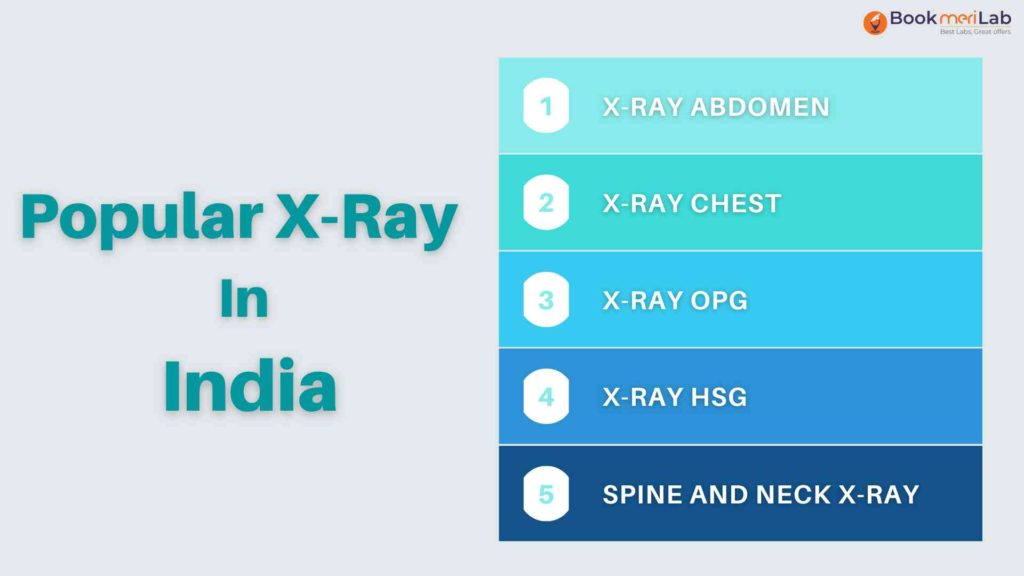
Some form of x-rays are very popular for their role in medical diagnosis. Some of them are
When X-ray is focused on chest to find the abnormalities in the blood vessels, bones, heart, airways and lungs it is called chest X-ray. It is also used to find any presence of fluids and air in and around the lungs.
Chest X-ray or chest radiography is one of the most common X-ray used for diagnosis of abnormalities in lungs, chest and heart.
Chest X-rays are recommended in susceptible conditions such as-
Bone X-ray or bone radiography captures the image of the bones. It is done to find the fracture in the bones and to diagnose bone cancer. It is also used as a guide to repair the spine, replace joints and cure fractures.
Para nasal sinus X-ray or X-ray PNS is done to view the space round nasal cavity.
Water view X-ray PNS is used to detect any infection in the sinus. Water view X-ray PNS test uses radiation through the chin at a certain angle. It is used to detect problems in the frontal and maxillary sinus. It is also used to find out any tumor in the sinus.
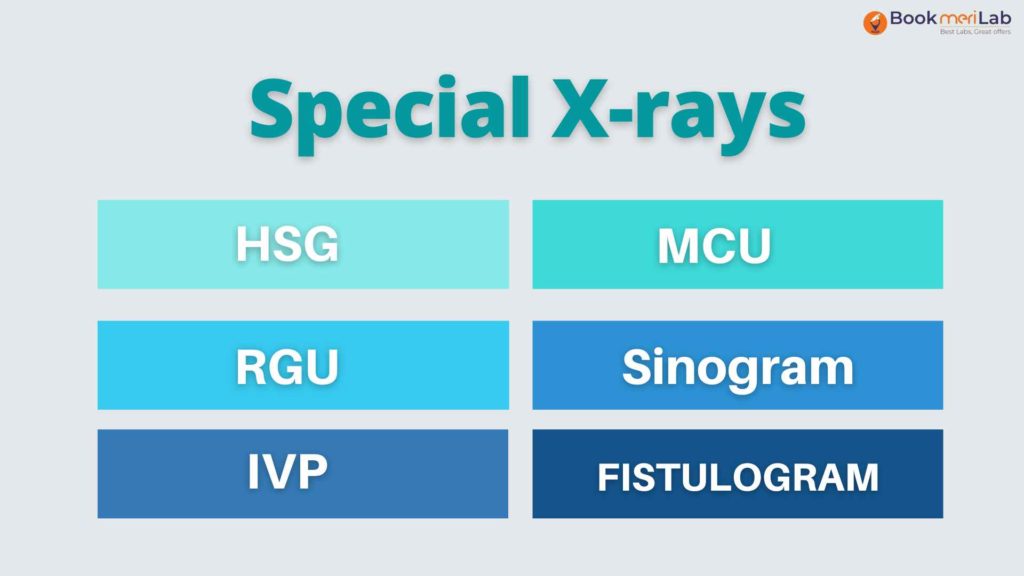
X-Ray HSG
It is an X-ray used to examine the uterus and fallopian tube in females. It uses fluoroscopy and a contrast material.
HSG is used to find the shape of the uterus and any blockage in the fallopian tubes.
The test is done in females with infertility problems.
MCU
Micturating cysto-urethrogram or MCU X-rays examines the urinary bladder.
The test is used to study the change of size and shape of the bladder while the person passes urine.
RGU
Retrograde urethrogram or RGU is a special X-ray done to examine urethra.
The test is usually performed in males.
It is used to look for any abnormalities in the urine passage.
Sinogram
Sinogram X-ray is used to examine the wound.
It is performed after draining the abscess to check the cavity and any fistula.
IVP
Intravenous pyelogram X-ray injects contrast material to examine kidney, ureters and bladder.
Iodinated contrast material is injected in the veins.
Different views in X-ray is obtained by changing the position and direction of the body. Most common view of X-rays are –

Posteroanterior or X-ray PA view is the position when the patient stands facing the flat surface and X-ray enters through the back and exits from the front part of the body.
Anteroposterior or X-ray AP view is the reverse of the posteroanterior view. The X-ray enters from the front part of the body and exits from the back.
In lateral view the X-rays enters from the side of the body part and exits from the other side.
The procedure depends upon the type of X-ray to be performed. However, the following set of procedures is common in most of the cases.
An X-ray report includes following characteristics –
X-rays have become one of the fastest, safest, and most efficient ways of detecting bone fractures, infections, tumors, and any abnormality of bones and even some soft tissues. Besides being non-invasive, easily accessible, and assisting physicians in making correct diagnoses and treatment plans, they play a significant part in medical diagnostics. The dose of radiation is quite small; however, a certain level of caution is advised, particularly for expectant mothers. In general, X-rays are a major source of valuable data, which ensure early detection, continuous surveillance, and have positive implications for patient care, thus, are an indispensable part of medical diagnostics in the modern era.
X-rays can detect fractures, bone infections, arthritis, pneumonia, lung infections, tumors, and some dental problems.
Results are given in a few minutes to a few hours at most, depending on whether a radiologist’s report is needed or not.
The first five uses of X-rays are fracture detection, joint and bone assessment, dental evaluation, chest and lung imaging, and identifying tumors.
Most X-rays are non-fasting, so you can eat without any problem.
Yes, X-rays can detect bone tumors or abnormal growths; however, CT or MRI may give more details.
The X-ray price in India covers the range from ₹300 to ₹500 depending on the type and center.
Dr Bhumika Rana is a Bachelor of Ayurvedic Medicine & Surgery (B.A.M.S.). Earlier She was an Operation Specialist at AIIMS Delhi & a Medical officer with the National health mission.
A Discount Providing Platform on all Diagnostic Services at your nearest Labs. 100's of Certified Labs, Assured Quality & Great Discounts.
