
A prothrombin time (PT) test measures the time to form a blood clot in a blood sample. The Coagulating or clotting factors are substances(proteins) that thicken the blood. Prothrombin is a coagulating factor. Our liver produces Prothrombin protein. When a person gets an injury or a cut that causes bleeding, clotting factors function together to form a blood clot. The low-level Clotting factor causes excessive and difficult to control bleeding after an injury. The high-level Clotting factors cause dangerous clot formation in your arteries or veins.
The PT test results are expressed as INR calculations. INR stands for the International normalised ratio (INR). INR test assesses the risk of bleeding or coagulation in the patients.
| Also known as | Blood clotting test, PT Prothrombin Time. |
| Purpose | Blood clotting. |
| Preparation | No preparation is required. |
| Fasting | Need not fast. |
| Reporting time | 24 hours. |
The test price depends on the diagnostic centre, city and home collection. However, generally, it would range from Rs 210 to 390.
| Popular Lab | Price |
|---|---|
| Dr lalpathlab | Rs 350 |
| City X-ray | Rs 280 |
| Janta X-ray | Rs 270 |
| Ganesh diagnostics | Rs 210 |
| Mahajan Imaging | Rs 320 |
| National Imaging | Rs 245 |
| Prognosis laboratories | Rs 210 |
The table below lists the prices for popular diagnostic centres.
| City | Price |
|---|---|
| PT INR test cost in Delhi | Rs 210 to 350 |
| PT INR test cost in Gurgaon | Rs 270 to 350 |
| PT INR test cost in Chandigarh | Rs 245 to 315 |
| PT INR test cost in Chennai | Rs 270 to 350 |
| PT INR test cost in Kolkata | Rs 250 to 350 |
| PT INR test cost in Pune | Rs 252 to 330 |
| PT INR test cost in Hyderabad | Rs 270 to 350 |
| PT INR test cost in Mumbai | Rs 240 to 390 |
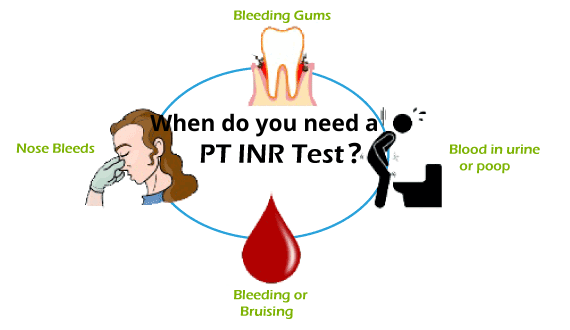
A PT/INR test has applications in
The changes in the Prothrombin level in pregnant women are depicted in the following table.
| Units | Non-pregnant adult | First trimester | second trimester | third trimester |
|---|---|---|---|---|
| Prothrombin plasma time (in seconds) | 12.7 to 15.4 | 9.7 to 13.5 | 9.5 to 13.4 | 9.6 to 12.9 |
The table indicates the normal PT/INR Range values.
| PT/INR Range | Result |
|---|---|
| Less than or equal to 1.1 | Normal |
| More than 1.1 | Above 1.1, your blood is clotting more slowly than normal |
| 2.0 to 3.0 | The general therapeutic range for people taking warfarin. |
High levels: High PT/INR result indicates slow blood clotting slowly, and a greater risk of bleeding. It also signifies high warfarin levels or doses in the body.
Low levels: Low PT/INR result indicates the insufficient dose of warfarin which prevents blood clotting.
Vitamin K has a role in producing various blood clotting proteins. For, e.g. Prothrombin is a vitamin K-dependent protein and is directly involved in blood clotting. Vitamin K also makes Osteolactin, which is responsible for healthy bone tissue.
The picture given below represents the sample report.
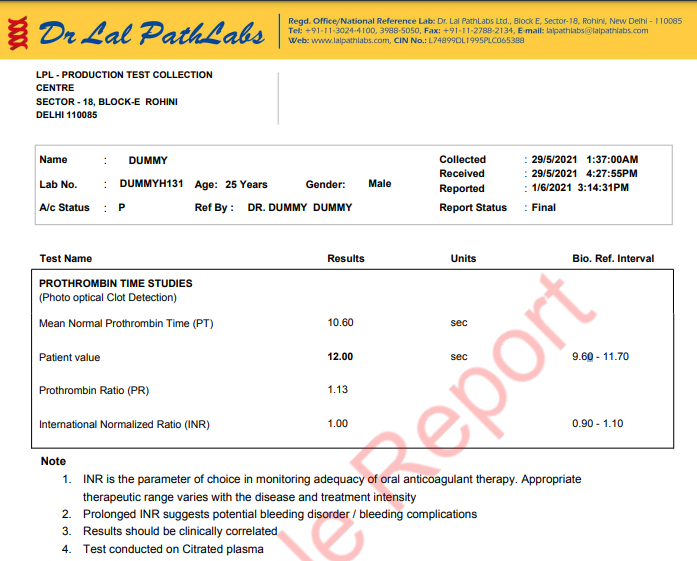
The WHO gives the standard calculation formula for finding INR. It is calculated as a ratio of the patient’s Prothrombin to a control Prothrombin standardised for the test.
INR = Patient PT ÷ Control PT.
High PT/INR result indicates too slow blood clotting slowly, and a greater risk of bleeding. It also signifies high warfarin levels or doses in the body.
Stroke, The lack of Prothrombin causes stroke in young children. This is because of the low function of the prothrombin gene.
Case-1: If the patient is taking warfarin.
If you are taking warfarin, there would be two subcategories of results given below.
Low INR Levels: Risk for dangerous blood clots formation.
High INR levels: Risk for dangerous and excessive bleeding.
Case-2: If the patient is not taking warfarin.
The INR test ranges are referred to if the patients are not taking warfarin. Please refer to the normal ranges in this informative article.
Our blood has many chemicals flowing in it. Some Chemicals have a clotting function. These functions are known as Clotting factors. There are various types of blood clotting factors like Factor I(fibrinogen), Factor II(Prothrombin), Factor III(Tissue Factor), etc.
Vitamins and food that increase blood clotting (Coagulation)
Vitamins and food that decrease blood clotting (Coagulation)
If the patients are already taking warfarin, they may need to delay their daily dose consumption until after the test.
The patients should consult their Doctor for any preparations.
aPTT is an activated partial thromboplastin time (aPTT) in which an activator speeds up the clotting time and results. And thus, it is more sensitive than the PTT.
The Bleeding and Clotting time test is a test that measures the time taken for the blood sample to clot or coagulate. Bleeding time is the time of stoppage of bleeding. This test is also known as the BT CT test.
The aPTT test monitors the response of heparin therapy in the patients.
References:
A Discount Providing Platform on all Diagnostic Services at your nearest Labs. 100's of Certified Labs, Assured Quality & Great Discounts.
