
Purpose
How
Prepare
Results
Cost
Fibroscan is a special ultrasound that is used to detect the stiffness of the liver. It is a non-invasive test, used to determine the health of a liver. Fibroscan test uses the ultrasound technique to look for any scar on the liver. Fibroscan test price in India starts at Rs 2000 and may go up to Rs 5000. A doctor uses a special ultrasound machine for the test.
A Fibroscan test, also called ultrasound elastography, is a simple test that checks how stiff or soft your liver is. It uses sound waves (ultrasound) to see if your liver has any damage, scars, or other problems. Doctors use this test to get a clear picture of how healthy your liver is. You can also check here the Fibroscan cost in Delhi.
Before you go for a Fibroscan, here are a few things to keep in mind:
Talk to Your Doctor: If you’re pregnant or have a device inside your body (like a pacemaker), make sure to tell your doctor before the test.
Fibroscan test is used by doctors to look for any disease or abnormal liver conditions. The scan is used by the doctors for diagnosis and to make a better treatment plan. Some Important findings are
The Fibroscan test price depends on city, lab and type of the scan. The cost varies depending upon the lab and the city.
| City | Price Starting from |
|---|---|
| Bangalore | ₹ 1270.00 |
| Noida | ₹ 1990.00 |
| Faridabad | ₹ 1985.00 |
| Ghaziabad | ₹ 1990.00 |
| Visakhapatnam-Vizag | ₹ 2035.00 |
| Delhi | ₹ 2132.00 |
| Gurugram / Gurgaon | ₹ 2138.00 |
| Sonipat | ₹ 2253.00 |
| Patna | ₹ 5150.00 |
| Navi-Mumbai | ₹ 5210.00 |
| Mumbai | ₹ 5390.00 |
| Thane | ₹ 5205.00 |
People suffering from fibrosis or the presence of a scar in the liver are usually asymptomatic. A Fibroscan test is required if you have the following symptoms of liver disease
Fibroscan test is commonly used for diagnosis of following liver conditions
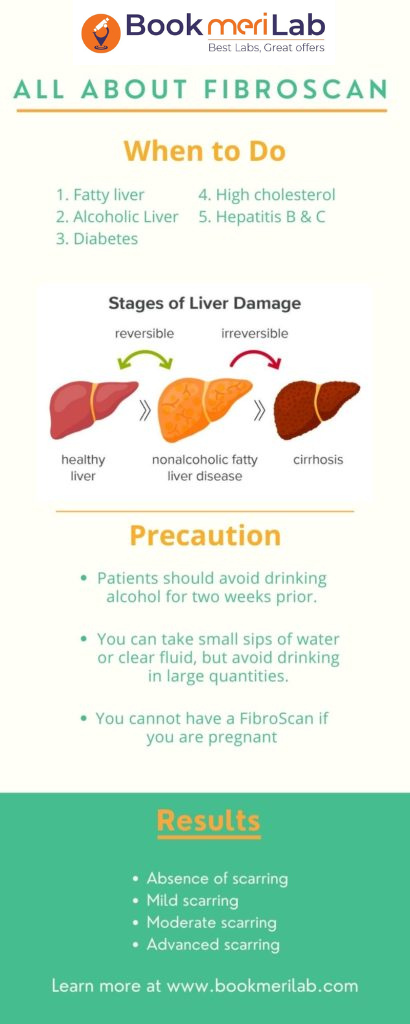
The procedure is very similar to an ultrasound scan.
Usually, no prior preparation is needed however, do keep in mind the following
There is no risk linked with the ultrasound fibroscan test.
Fibroscan measures the extent of stiffness in the liver in terms of kPa (kilopascals). The fibroscan result may show
People always wanted to know the normal range of the Fibroscan. They can measure their results through kPa and its results range from 2.5 kPa to 75 kPa. Between 90–95% of healthy people without liver disease will have a liver scarring measurement <6.0 kPa (median is 5.3 kPa). This means the normal range for a FibroScan is between 2 to 6 kPa.
| KPA Reading | Assessment | Fibrosis Score |
|---|---|---|
| 0-6 Kpa | Normal | F0-F1 |
| 6-12 Kpa | Fibrosis | F2-F3 |
| 12+ Kpa | Cirrhosis | F4 |
FibroScan is an effective and accurate non-invasive diagnostic tool which is used to measure the liver’s flexibility as well as the extent of liver fibrosis. The process is simple and the results are available in no time, making it a patient-friendly test. It is a great aid to physicians in the early detection of liver disorders, following the course of the illness, and determining the efficiency of the therapy. Generally speaking, FibroScan is a primary instrument in the control of liver diseases, ensuring prompt treatments and avoiding any serious liver sequel.
What is the FibroScan test for?
The FibroScan test checks how stiff or soft your liver is, helping doctors see if there’s any damage or scarring.
What is a normal FibroScan result?
A normal FibroScan result shows a liver stiffness between 2 to 6 kPa, which means your liver is healthy.
What does a FibroScan cost?
The FibroScan test costs between ₹2000 to ₹5000 in India, depending on the city and the lab.
What are the symptoms of liver fibrosis?
Symptoms of liver fibrosis can include tiredness, itchy skin, yellowing of the skin, weight loss, or swelling in your legs.
Can I drink water before a FibroScan?
Yes, you can drink small sips of water before the test, but avoid drinking large amounts.
What is the danger range for a FibroScan?
A FibroScan result above 12 kPa suggests serious liver damage or cirrhosis, which needs immediate attention.
Do I need to prepare for the Fibroscan Test? Are there any dietary restrictions?
You should avoid eating for three hours before the test and not drink alcohol for two weeks.
Is the Fibroscan Test painful or uncomfortable?
No, the FibroScan test is painless. You may feel slight vibrations, but it’s generally comfortable.
How long does the Fibroscan Test take, and when will I receive the results?
The test takes about 10-20 minutes, and you usually get your results right after the test.
Can I get the Fibroscan Test done at home, or do I need to visit the clinic?
You need to visit a clinic or hospital to get the FibroScan test done. It’s not available at home.
Who should consider getting a Fibroscan Test?
Anyone with liver problems like hepatitis, liver cirrhosis, or fatty liver should consider a FibroScan test.
How often should I get a Fibroscan Test if I have liver issues?
Your doctor may recommend getting a FibroScan test once a year or as needed based on your liver condition.
Are there any risks or side effects associated with the Fibroscan Test?
No, the FibroScan test is very safe and doesn’t have any side effects.
What conditions can the Fibroscan Test diagnose or monitor?
It helps diagnose or monitor conditions like hepatitis, fatty liver disease, cirrhosis, and liver scarring.
What are the next steps if my Fibroscan results indicate liver problems?
Your doctor will suggest treatments or lifestyle changes and may recommend more tests to understand your liver condition better.Can I eat or drink after the Fibroscan Test?
Yes, you can eat and drink normally after the FibroScan test. No restrictions apply.
Dr Bhumika Rana is a Bachelor of Ayurvedic Medicine & Surgery (B.A.M.S.). Earlier She was an Operation Specialist at AIIMS Delhi & a Medical officer with the National health mission.
A Discount Providing Platform on all Diagnostic Services at your nearest Labs. 100's of Certified Labs, Assured Quality & Great Discounts.

मैडम मै लिवर से बहुत परेशान हू। रिपोर्ट मे सब नार्मल है। चक्कर कमजोरी थकान से परेशान हूं।
मैडम मै लिवर से बहुत परेशान हू। रिपोर्ट मे सब नार्मल है। चक्कर कमजोरी थकान से परेशान हूं।
Function Test-2(Mini) Proteins (Serum) Total Protein (Biuret) 7.4 g/dL 6.4-8.3 Note: Change in reference range Albumin (Colorimetric) 5.1 g/dL 3.5-5.2 Please note change in Reference range Globulin 2.30 g/dL 1.8-3.6 A/G Ratio (Calculated) 2.22 1.1-2.2 BilirubinTotal, Direct, IndirectSerum (Serum) Bilirubin-Total (Diazo) 3.64 mg/dL 0-1.2 Medical Remarks: On follow up Bilirubin-Direct (Diazo) 0.92 mg/dL 0.0-0.3 Bilirubin- Indirect (Calculated) 2.72 mg/dL 0.1-1.0 SGPT (ALT) (Serum,Enzymatic) 89.9 U/L 0-41 Note: Change in reference range. SGOT (AST) (Serum,Enzymatic) 51.0 U/L 0-40 Note: Change in reference range. Alkaline Phosphatase (Serum,pNPP) 125 U/L 40-129 Note : Change in reference range Gamma GT (GGTP) (Serum,Enzymatic) 26 U/L < 60 Note: Change in reference range — End of Report —
Function Test-2(Mini) Proteins (Serum) Total Protein (Biuret) 7.4 g/dL 6.4-8.3 Note: Change in reference range Albumin (Colorimetric) 5.1 g/dL 3.5-5.2 Please note change in Reference range Globulin 2.30 g/dL 1.8-3.6 A/G Ratio (Calculated) 2.22 1.1-2.2 BilirubinTotal, Direct, IndirectSerum (Serum) Bilirubin-Total (Diazo) 3.64 mg/dL 0-1.2 Medical Remarks: On follow up Bilirubin-Direct (Diazo) 0.92 mg/dL 0.0-0.3 Bilirubin- Indirect (Calculated) 2.72 mg/dL 0.1-1.0 SGPT (ALT) (Serum,Enzymatic) 89.9 U/L 0-41 Note: Change in reference range. SGOT (AST) (Serum,Enzymatic) 51.0 U/L 0-40 Note: Change in reference range. Alkaline Phosphatase (Serum,pNPP) 125 U/L 40-129 Note : Change in reference range Gamma GT (GGTP) (Serum,Enzymatic) 26 U/L < 60 Note: Change in reference range — End of Report —