
Purpose
How
Prepare
Results
Cost

The ESR test (Erythrocyte Sedimentation Rate) is a simple yet crucial blood test that helps detect inflammation in the body. It measures how quickly red blood cells (RBCs) settle at the bottom of a test tube within an hour. A higher-than-normal ESR may indicate infections, autoimmune diseases, or chronic inflammatory conditions. Usually, the cost of an ESR test in India ranges from Rs 100 to Rs 300, depending on the diagnostic center and location. In many cases, doctors may also recommend a CBC ESR test for a more comprehensive analysis.
| Also Known As | SED Test, Erythrocyte Sedimentation Rate or ESR |
| Purpose | Inflammation or infection |
| Preparation | Overnight fasting is preferred |
| Fasting | Preferred |
| Reporting Time | 8 to 24 Hrs. |
| Price | Rs. 100 to Rs. 300 |
The ESR test price in India usually ranges between Rs 100 to Rs 300. However, the exact cost may vary depending on factors such as the diagnostic center, city, and additional lab charges. Some well-known diagnostic centers may have slightly higher prices due to advanced testing facilities and quicker report delivery.
If you’re planning to get an ESR test, it’s always a good idea to compare prices at different labs in your city.
| Name of Diagnostic Center | Test Price (Rs) |
|---|---|
| Redcliffe Labs | Rs 117 |
| Dr Lal Pathlabs | Rs 130 |
| Vijaya Diagnostics | Rs 250 |
| SRL Diagnostics | Rs 128 |
| Metropolis Healthcare | Rs 130 |
Often, a doctor recommends ESR along with a CBC test. CBC measures the different blood components counts in our body. It along with the ESR test helps in better diagnosis and access the impact of infection or inflammation on the different blood counts.
Thus, the table below lists the CBC with ESR test prices in different cities of India:
The purpose of the test is to diagnosis the presence of infections, inflammation, tumors, or autoimmune diseases.
The Erythrocyte Sedimentation Rate test is also helpful to monitor some of the following diseases as well.
Common symptoms and conditions when a doctor may recommend this test is listed below
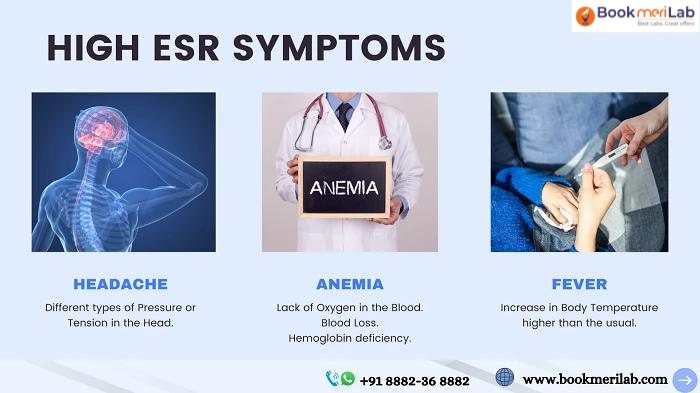
You must get your test done if you find any of the high ESR symptoms, which are mentioned below.
It is a simple blood test thus the procedure is the same as any other blood test.
Usually, the result is available within 24 hours after the test.
The ESR test does not require any special preparation however overnight fasting is preferred.
If you are under any medication, inform your doctor. You might be asked to stop medicines because certain medicines affect the Erythrocyte Sedimentation Rate test result.
It is a safe process and does not involve any risk or side effects.
However, people who are having sensitive skin might experience soreness and bruises at the site of vein puncture.
The Erythrocyte Sedimentation Rate test is measured by the two methods:
This is the most common method.
The method of this test is the same as the Westergren method but this method is inferior in sensitivity level to the Westergren method.
It is an easy, simple, inexpensive & non-specific test. However, it is fairly accurate thus very commonly used.
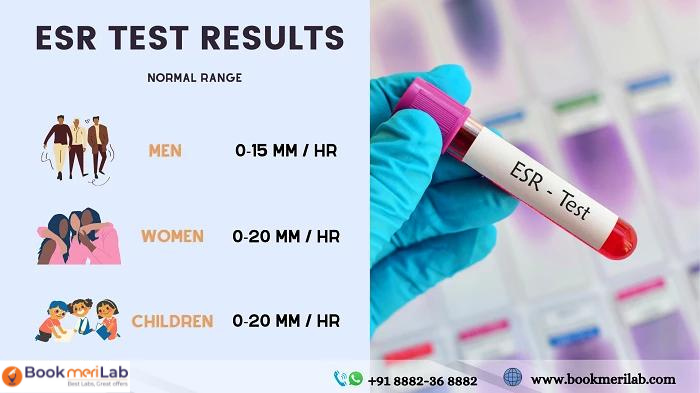
| Category | Normal Range |
|---|---|
| Men | 0-15 mm / hr |
| Women | 0-20 mm / hr |
| Children | 0-20 mm / hr |
You can download a sample report here.
The following factors contribute to the possibility of obtaining a high ESR rate:
The following factors contribute to the possibility of obtaining a low ESR rate:
An abnormal ESR result does not signify any disease. It only indicates inflammation in the body. To understand the underlying cause of inflammation, a Doctor may use other tests to diagnose the disease or cause. Thus, it is often prescribed along with the following tests:
ESR test results beyond the normal range can occur without any medical conditions. Your doctor will help you diagnose the cause if any medical condition is present.
Sources and References:
https://en.wikipedia.org/wiki/Erythrocyte_sedimentation_rate
ESR Test
The ESR test cost in India ranges between Rs 100 and Rs 300, depending on the diagnostic center and city you choose for the test.
The full form of ESR is Erythrocyte Sedimentation Rate, a test that measures the rate at which red blood cells settle in a test tube.
The ESR normal range is 0–15 mm/hr for men, 0–20 mm/hr for women, and 0–20 mm/hr for children, varying slightly by lab.
The ESR blood test detects inflammation by measuring RBC settling rates, while the CBC test evaluates blood components like red cells, white cells, and platelets.
ESR test results are usually available within 8 to 24 hours, depending on the diagnostic center’s processing time.
The Westergren method is more sensitive and widely used, while the Wintrobe method is less sensitive and not commonly preferred for testing ESR.
A high ESR rate may indicate inflammation, infections, autoimmune diseases, or conditions like rheumatoid arthritis, cancer, or heart and kidney disorders.
A low ESR rate can result from conditions like congestive heart failure, low plasma protein, sickle cell anemia, or polycythemia vera.
Dr Bhumika Rana is a Bachelor of Ayurvedic Medicine & Surgery (B.A.M.S.). Earlier She was an Operation Specialist at AIIMS Delhi & a Medical officer with the National health mission.
A Discount Providing Platform on all Diagnostic Services at your nearest Labs. 100's of Certified Labs, Assured Quality & Great Discounts.
