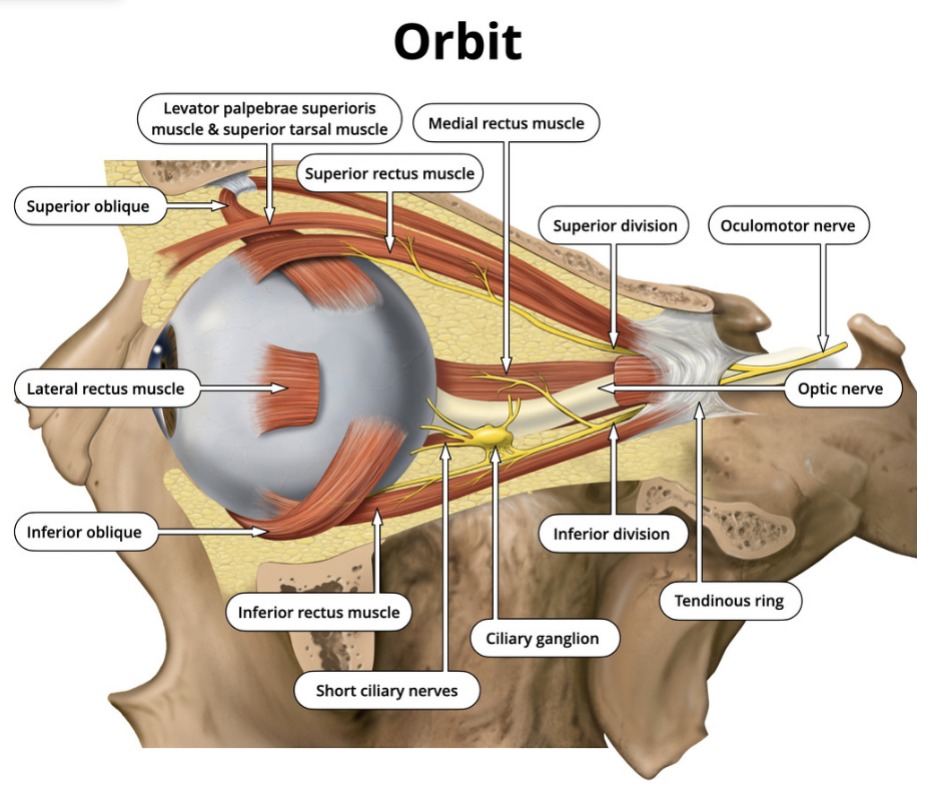
Magnetic Resonance Imaging (MRI) of the orbit is a type of diagnostic test that produces detailed images of the eye and surrounding structures such as the bones and muscles of the orbit (eye socket). It can help diagnose a variety of orbital conditions such as tumors, inflammation, and trauma, and can help identify the specific location, size, and shape of the problem. This test is non-invasive and does not involve exposure to ionizing radiation. It instead uses strong magnets, radio waves, and a computer for the generation of images.
The cost of MRI orbit in India can vary depending on several factors such as location, the type of MRI machine, and the type of facility. On average, the cost can range from Rs. 3000 to Rs. 8000.
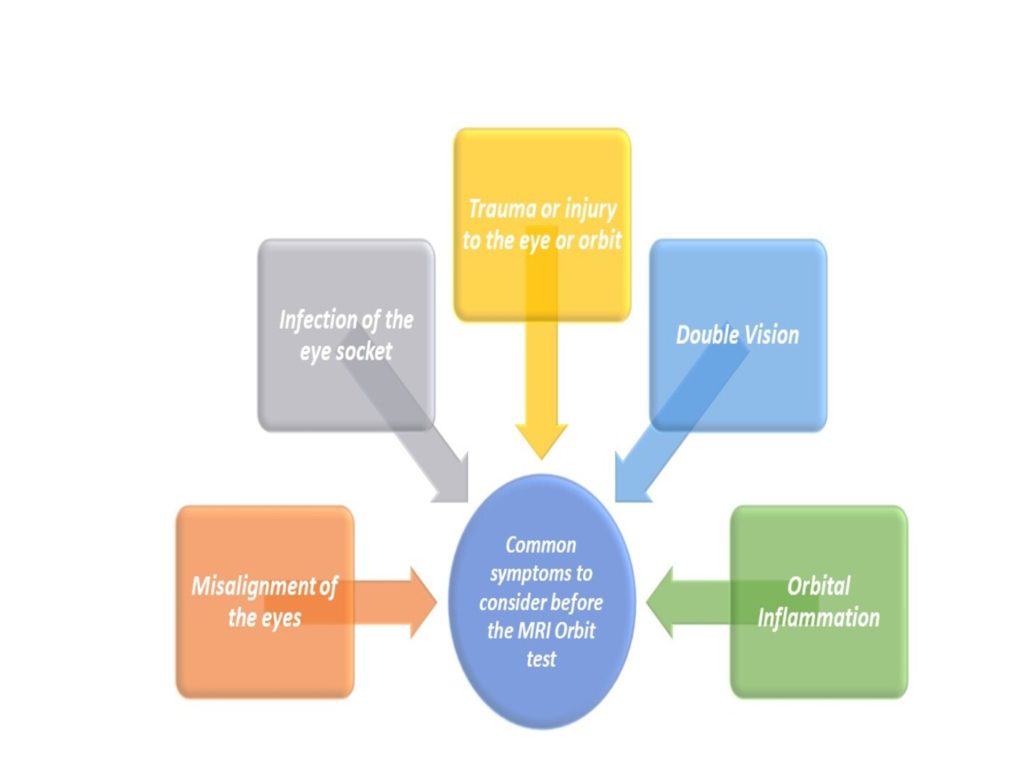
MRI Orbit is typically ordered when patients report unexplainable vision problems, persisting pain in the eyes, swelling, or the suspicion of nerve involvement. It can provide more details than the usual eye check or X-rays and so it is mostly preferred for the detection of tricky conditions. Also, a contrast dye may sometimes be injected during the procedure to give an enhanced view of the blood vessels or, say, to help identify inflammation or tumors more clearly. The procedure is very safe and totally painless, giving those with metal implants or pacemakers, however, the heads up to their doctor beforehand. Choosing the center for study will also affect the price of an MRI Orbit as well as the quality of the results. From beginning to end, always obey your doctor’s instructions for preparing yourself so that the photo will be accurate and dependable.
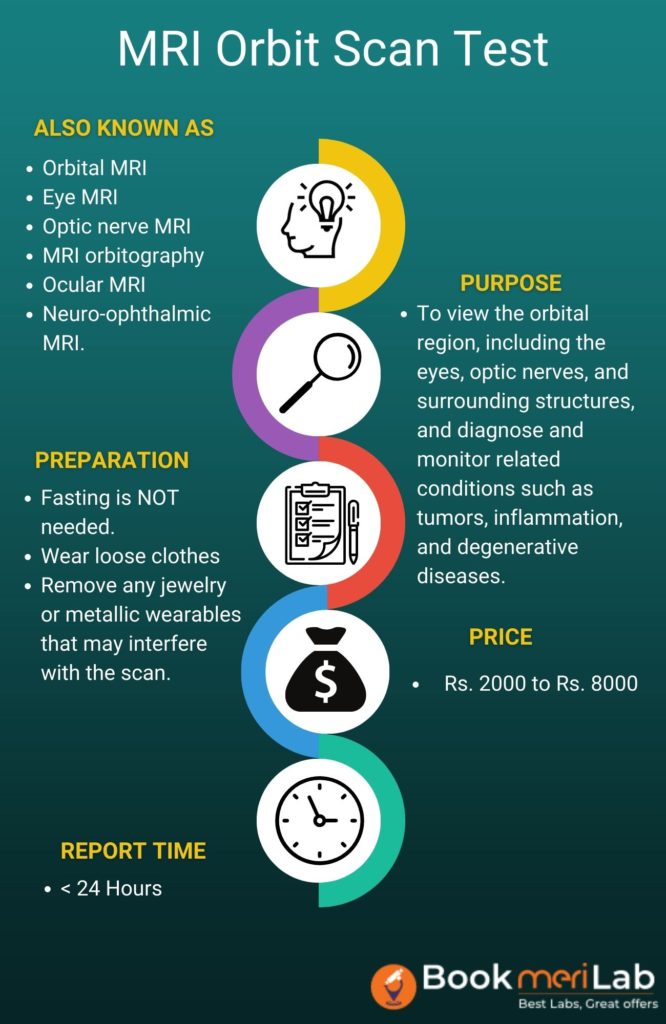
| Also Known As | Orbital MRI, ocular MRI, eye MRI, optic nerve MRI, Eye MRI, MRI orbitography, Ocular MRI, Neuro-ophthalmic MRI. |
| Purpose | To view the orbital region, including the eyes, optic nerves, and surrounding structures, and diagnose and monitor related conditions such as tumors, inflammation, and degenerative diseases. |
| Preparation | No special preparation is required. Remove metal objects, and wear comfortable clothing. |
| Fasting | No |
| Reporting Time | <24 hrs. |
| Cost | ₹ 2000 – ₹ 8000 |
MRI Orbit cost usually ranges from Rs 2000 to Rs 8000. However, it may go up in cases involving special scans or if the test involves the use of a contrast media. The actual price would depend on the type of study, MRI centre, city, and technology. Bookmerilab partner with more than 80 MRI centres in India and provide up to 50% discount. Contact us for more details.
The MRI Orbit prices at some of the Popular MRI centres in India are listed below. 10-50% discounts are available at the below prices.
| Diagnostic Centres | Price |
|---|---|
| City X-Ray | ₹ 4800 |
| Ganesh Diagnostics | ₹ 4800 |
| Mahajan Imaging | ₹ 7200 |
| Healthmap Gurugram | ₹ 2248 |
| Srivastava MRI-NOIDA | ₹ 5250 |
| PULSE IMAGING | ₹ 4550 |
| Chhatrapati Shivaji Maharaj Hospital – KRSNAA | ₹ 1785 |
| NM Medical | ₹ 7225 |
| Shree Krishna Diagnostics | ₹ 4900 |
| Aloka Medicare Pvt Ltd | ₹ 6650 |
| Vijaya Diagnostics | ₹ 7500 |
BookmeriLab has partnered with more than 80 MRI centres across India. We offer this test at an affordable starting price of Rs 2000 to Rs 8000. The table below shows the cost of ocular MRI in major cities.
| Cities | Price Range |
|---|---|
| MRI Orbit Test Price in Delhi | ₹ 1805 – ₹ 7200 |
| MRI Orbit Test Price in Gurgaon | ₹ 2247 – ₹ 7200 |
| MRI Orbit Test Price in Noida | ₹ 5250 – ₹ 7200 |
| MRI Orbit Test Price in Mumbai | ₹ 3285 – ₹ 7225 |
| MRI Orbit Test Price in Kolkata | ₹ 3150 – ₹ 6650 |
| MRI Orbit Test Price in Bangalore | ₹ 3285 – ₹ 8000 |
| MRI Orbit Test Price in Hyderabad | ₹ 3285 – ₹ 8000 |
| MRI Orbit Test Price in Chennai | ₹ 3150 – ₹ 8000 |
This test may be used for the following purposes-
The orbit refers to the bony cavity in the skull that houses and protects the eye and its associated structures. The orbit is made up of several bones, including the frontal bone, the zygomatic bone, the sphenoid bone, and the ethmoid bone. Within the orbit, several important structures are located, including the eye, the optic nerve, the lacrimal glands (which produce tears), and various muscles responsible for eye movement. Understanding the anatomy and function of the orbit is critical for accurately diagnosing and treating conditions that affect the eyes and surrounding structures.

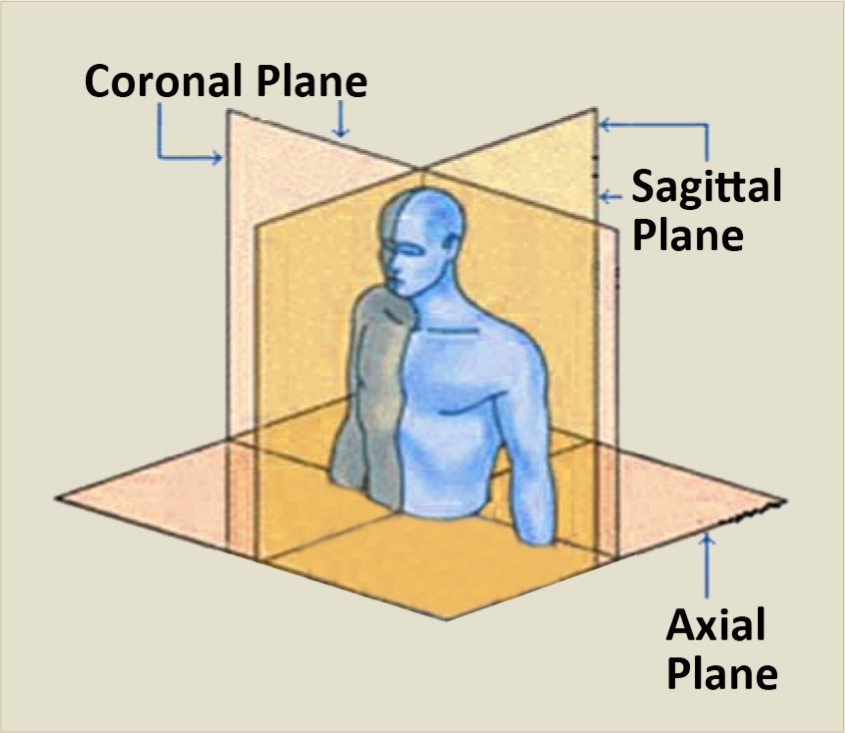
During the scan, your healthcare provider may employ a variety of scan sequences, including T1-weighted, T2-weighted, FLAIR, and sagittal or axial pictures, to obtain detailed views of the orbits. Your healthcare provider will make a decision on the best protocol and scan sequences depending on the purpose of the exam.
| Protocol | Indications |
|---|---|
| T1-weighted | Provides high-resolution images and is used to evaluate bone and soft tissue |
| T2-weighted images | Provides high-contrast images and is used to evaluate fluid-filled structures |
| FLAIR | To see any lesions or irregularities in the orbits |
| Gradient echo sequences | To evaluate the optic nerve and blood vessels |
| Gadolinium contrast | To enhance the visibility of certain structures. |
| Fat-saturation sequences | To reduce the effects of fat in the images |
| Sagittal and axial pictures | To display the orbits in various planes |
The specific protocols used in an MRI orbit scan can be adjusted depending on the clinical indication and the referring physician’s preferences.
MRI Orbit has been advanced as an imaging technique that provides a clear view of the eye and orbital structures around it for doctors. It may be of help in cases in which conventional eye-examination methods and simpler imaging tests fail to provide the diagnosis. Here is a brief list of benefits:
1. Provides detailed visualization
MRI Orbit can provide highly sharp and accurate images of structures present in the eye socket, optic nerve function, and nearby muscles. Detecting structural and functional abnormalities early means that corrective measures can be taken at an early stage.
2. Early diagnosis of disease
The scan can be used effectively in diagnosing tumors, infections, or inflammatory conditions before they show serious effects. An early diagnosis usually increases the chance of curing the issue.
3. Safe and non-invasive
Since MRI works with magnetic fields and radio waves as opposed to X-rays, no dangerous radiation is involved. This justifies its safety for use in most types of patients, including children who may have to undergo repeated imaging.
4. Useful in nerve assessment
Disorders of the optic nerves can be studied thoroughly, whether due to neuritis, compression, or injury, which benefits the planning of treatment for stopping the patient from losing vision.
5. Assists surgical preparation
MRI Orbit provides accurate information that can assist the surgeon in surgery for orbital fractures, tumors or other ocular concerns.
6. Evaluates adjacent regions
The exam considers not only the eye but evaluates adjacent areas as well – such as the brain and sinuses – providing a reflexive view of a possible problematic condition.
7. Option for contrast scanning
If the patient has contrast material in the scan, the doctor can properly evaluate blood vessels and abnormal tissues for accurate assessment.
MRI Orbit is the safe, reliable, comprehensive option that allows doctors to assess and treat many ocular and orbital circumstances with confidence.
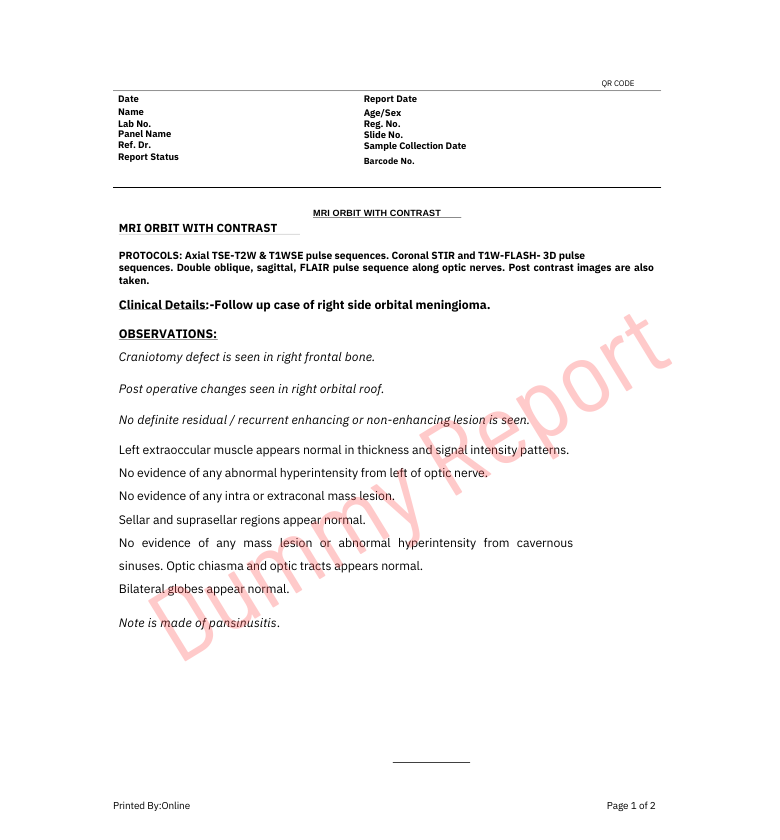
A typical MRI orbit scan shows clear images of the bones, muscles, and other components in the eye and adjacent areas. The usual anatomical details will be visible in these photos. The optic nerve, eyelid muscles, eye socket bones, muscles that move the eye, and orbital fat will all be evident.
A scan with abnormal results could indicate the existence of tumors, inflammation, or other problems. Some common findings in MRI scans include:
| MRI Brain | MRI Orbit | |
| Purpose | MRI Brain is used to examine the brain and its structures. | MRI Orbit is used to examine the eye and surrounding structures. |
| Anatomic Coverage | MRI Brain covers the entire brain. | It focuses on the eye and surrounding structures such as the eye socket, muscles, and nerves. |
| Techniques | Different sequences are used in MRI Brain. | This test optimizes the images of the specific structures being examined. |
| Indications | MRI Brain is used for a variety of neurological conditions. | MRI Orbit is used for conditions affecting the eye and surrounding structures. |
In conclusion, MRI is a crucial tool for diagnosing illnesses of the orbit. It makes it possible to image the eye and its surroundings in great detail, giving researchers the data they need to diagnose, treat, and monitor orbital disorders. It is crucial to utilize the appropriate methodology and scan sequences to improve the photographs. With advancements in technology, the MRI orbit scan is becoming increasingly precise and efficient and is a valuable tool for healthcare professionals to diagnose and treat various ocular and neurological conditions. As with any medical procedure, it’s important to discuss the benefits and risks with a healthcare provider to determine if an MRI Orbit scan is appropriate for your individual needs.
An MRI orbit scan is a non-invasive medical imaging test. It uses a powerful magnetic field, radio waves, and a computer to produce detailed images of the eye and surrounding structures.
An MRI orbit scan is performed to diagnose and evaluate a wide range of conditions affecting the eye and surrounding structures. Such as tumors, infections, and inflammation.
No, an MRI orbit scan is not painful. It is a non-invasive procedure and you will only feel the sensation of the table moving and the machine making noise.
The length of an MRI orbit scan can vary depending on the specific area being examined and the type of scan being performed. It typically takes between 30 and 60 minutes.
An MRI orbit scan is generally considered safe and has no known side effects. However, individuals with certain types of metal in their body such as cochlear implants, aneurysm clips, and some pacemakers may not be able to undergo an MRI.
After an MRI orbit scan, you can return to your normal activities. The radiologist will review the images and provide a report to your referring physician who will discuss the results with you.
Yes, an MRI Orbit scan can detect eye tumors and other abnormalities around the eyes, optic nerves, and surrounding structures with great clarity.
MRI Orbit can help identify several eye-related conditions, such as inflammation, infections, nerve damage, tumors, and injuries that may not be visible on a regular scan.
The cost of an MRI Orbit scan generally ranges between ₹3,000 to ₹8,000, depending on the city, diagnostic center, and whether contrast dye is used.
In most cases, you can eat and drink normally before the test unless your doctor specifically advises fasting, especially if contrast material will be used.

A Discount Providing Platform on all Diagnostic Services at your nearest Labs. 100's of Certified Labs, Assured Quality & Great Discounts.