
USG KUB, or Renal Ultrasound, is an ultrasound of the kidneys, ureter, and urinary bladder. This test examines and diagnoses any abnormality in the urinary system. Doctors may also recommend USG KUB as a diagnostic tool to assess the prostate gland in males. Ultrasonography, or ultrasound uses high-frequency sound waves to examine these organs. USG being a non-invasive (non-surgical) procedure, is helpful for healthcare professionals in looking for any abnormality in the nerves, tissues, and organs of the urinary system. USG KUB Scan price ranges between Rs 500 to Rs 1000.
Patients showing symptoms like frequent urination, abdominal pain, presence of blood in urine, or if kidney stones are suspected, a USG KUB scan is generally advised. Through such a scan, the doctors can easily visualize the patient’s urinary tract, enabling them to identify any infections, obstructions, or structural abnormalities. The test is very safe for people of all ages, is very quick, and does not involve any radiation, thus, it is also suitable for children and pregnant women. That’s why it is an indispensable instrument for early diagnosis and therapy management.

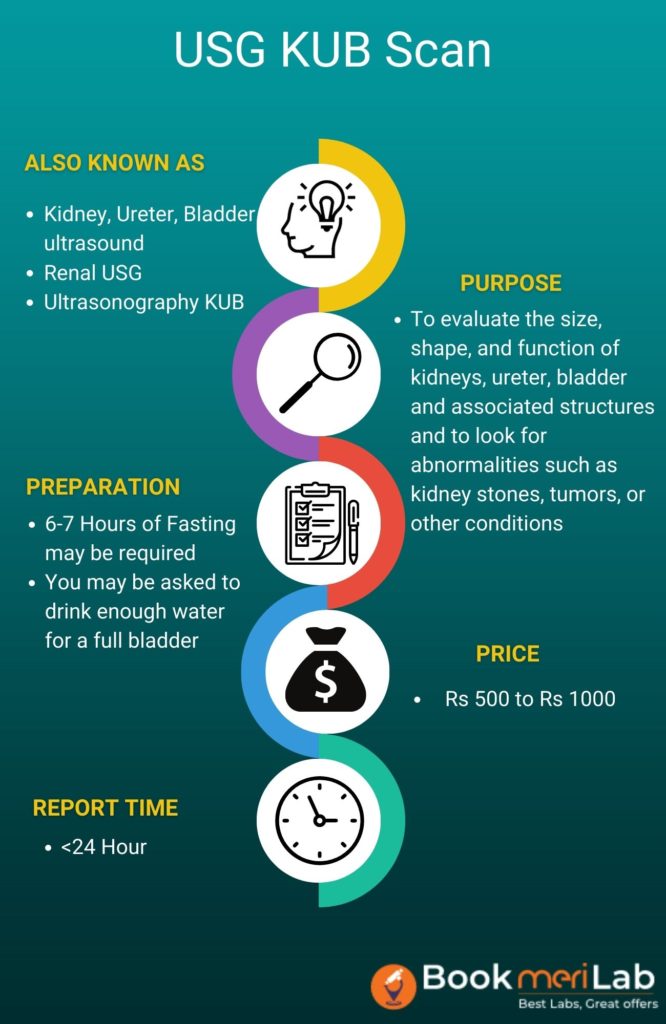
| Also Known As | Kidney, Ureter, Bladder ultrasound; Renal USG, Ultrasonography KUB. |
| Purpose | To evaluate the size, shape, and function of kidneys, ureters, bladder, and associated structures and to look for abnormalities such as kidney stones, tumours, or other conditions. |
| Preparation | No special preparation is required. Drink enough water for a full bladder. |
| Fasting | 6-7 Hours of fasting may be required |
| Machine Used | Ultrasound Machine |
| Reporting Time | <24 Hrs. |
| Cost | Rs. 500 to Rs. 1000 |
The USG KUB test price in India ranges from Rs 500 to Rs 1000, depending on the city and lab. In India, Bookmerilab collaborates with more than 472 diagnostic facilities. We give medical diagnostic tests a 10–50% discount.
Below is prices at some of the popular diagnostic centres in India.
| Diagnostic Centres | Test Price |
|---|---|
| Janta X-Ray Clinic | ₹ 980 |
| Mahajan Imaging | ₹ 1620 |
| Pulse Imaging | ₹ 1050 |
| Aarthi Scans | ₹ 900 |
| Shree Krishna Diagnostics | ₹ 560 |
| Vijaya Diagnostic Centre | ₹ 1350 |
The cost of USG KUB Ultrasound may differ in different cities in India:
| Cities | Test Price |
|---|---|
| USG KUB Price in Delhi | ₹ 600 – ₹ 1620 |
| USG KUB Price in Gurgaon | ₹ 900 – ₹ 1995 |
| USG KUB Price in Noida | ₹ 850 – ₹ 1710 |
| USG KUB Price in Kolkata | ₹ 1140 – ₹ 1600 |
| USG KUB Price in Hyderabad | ₹ 380 – ₹ 1350 |
| USG KUB Price in Bangalore | ₹ 900 – ₹ 1045 |
| USG KUB Price in Chennai | ₹ 990 – ₹ 1600 |
The KUB Ultrasound test is recommended in conditions such as:
The test does not require much preparation. You may need to fast for a few hours before the test and drink water before the procedure to keep the bladder full. The bladder can be examined properly when the bladder is full. No fasting is required for USG KUB.
Other instructions may be given depending on your health conditions.
There are no risks associated with USG KUB. The procedure is painless, non-invasive, and does not use dye. Since it is a noninvasive test that does not use ionising radiation, it is safe for pregnant women.
The results of the USG KUB test will be interpreted by a trained healthcare provider, who will look for any abnormalities or abnormalities in the size, shape, and structure of the organs and tissues being imaged.
The Normal USG KUB result suggests the absence of diseases of the kidneys like kidney cysts, kidney stones, and obstruction in the ureters.
The Normal USG KUB result suggests the presence of diseases of the kidneys like kidney cysts, kidney stones, and obstruction in the ureters. For example, if the test shows an enlarged kidney or a blockage in the ureter, it may indicate the presence of a kidney stone or other issues. Similarly, if the test reveals an abnormal shape or size of the bladder, it could be a sign of bladder cancer or another issue.
Here is the test sample report Male:
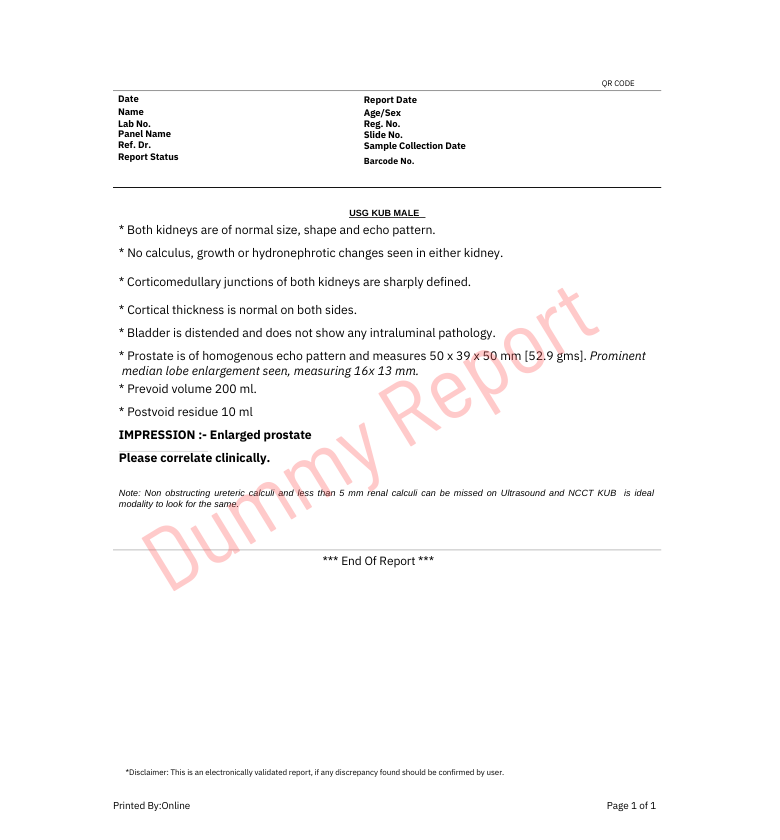
After urinating, there is always some urine left in the bladder. Post Void Residual (PVR) is a measurement of the amount of urine left in the bladder after urination. If PVR is more than usual, it indicates an abnormality in the ureter or bladder. It is commonly measured using ultrasonography (USG) of the kidneys, ureters, and bladder (KUB). A normal post-void residual is less than 50 milliliters, while a high post void residual may indicate urinary incontinence, bladder outlet obstruction, or other urinary tract disorders
The Role of the Kidney is to purify the blood and remove the waste material. The waste material urine is stored in a bladder. The residual urine in the bladder is measured using USG KUB, also called PVR ultrasound. A high PVR can be a sign of an issue with the bladder or urinary system, such as an obstruction or bladder dysfunction. There is a link between USG KUB and PVR in that USG KUB can help to identify any abnormalities or issues in the kidneys, ureters, and bladder that may be causing a high PVR. If an issue is identified through USG KUB, further testing or treatment may be necessary to address the issue and improve the PVR.
Overall, USG KUB is a relatively quick and non-invasive way to examine the kidneys, ureters, and bladder, while the other abdominal ultrasounds and CT scans are more comprehensive and specialized.
There are some benefits of KUB Ultrasound:
USG KUB test is noninvasive, painless, and relatively quick, making it a useful tool for diagnosing and monitoring kidney problems. However, there are a few limitations to keep in mind when considering an ultrasound KUB.
The results of a KUB ultrasound can provide valuable information to help diagnose and manage kidney-related conditions, such as kidney stones, kidney infections, and kidney abnormalities present at birth (congenital abnormalities). The test can also be used to monitor the progression of chronic kidney disease and to assess the effectiveness of treatment for kidney conditions. In conclusion, renal ultrasound or USG KUB is a useful tool for diagnosing and monitoring kidney problems, but it has limitations in terms of the level of detail it can provide and the conditions it can detect. It is important to discuss all available options with a healthcare provider to determine the best course of action for diagnosis and treatment.
No. You can not use the USG KUB test to detect your unborn baby’s health in the womb.
Yes, it can. It depends from doctor to doctor. Generally speaking, doctors majorly use CT and MRI tests for tumour detection.
Both tests are similar and slightly different. The USG abdomen can detect issues in all the organs located in the abdomen. But, the USG KUB detects issues in the bladder, ureter, and kidneys.
Yes. The KUB ultrasound can detect kidney diseases.
You shall drink around one pint of water before the test.
No. You can not perform the USG KUB test during pregnancy.
Yes. KUB ultrasound can detect cancer.
Generally, patients are instructed to not eat for a few hours before the test, so that the produced images of the kidneys, ureters, and bladder are clear.
Signs of the disease may be: swelling, tiredness, changes in the amount of urine, backache, vomiting, or high blood pressure.
USG KUB in India costs with a range of ₹500 to ₹1,000 on average depending on the center and the city.
The scan allows the visualization of the urinary bladder, ureters, and kidneys and can confirm the presence of stones, cysts, or other abnormal growths.

Dr Garima Saroj is a dentist from Manipal college of dental sciences. She has previously worked at ESIC dental college and hospital Delhi and Dentecare multispecialty dental clinic Gurugram. She has a passion for writing for patient education and awareness.
A Discount Providing Platform on all Diagnostic Services at your nearest Labs. 100's of Certified Labs, Assured Quality & Great Discounts.
