ECG Test (Electrocardiography) examines the abnormalities in the heart rhythm due to heart diseases. It may also indirectly indicate the cause of Cardiac arrest, irregular heartbeat, and insufficient oxygen supply to the heart. It is a non-invasive, painless and graphical information result based test. This test is usually prescribed to mid-aged and older patients. Its price in India ranges from Rs 150 to Rs 400.
Your doctor can recommend an ECG test to diagnose:
Increased or Decreased heartbeat
Irregular heartbeat
Blood clot
Defects related to heart since birth
Heart attack
What happens in an ECG Test?
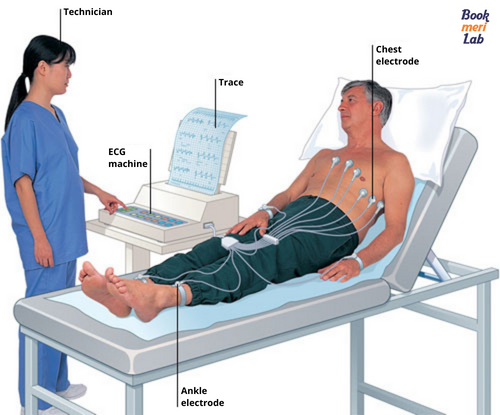
The ECG (Electrocardiogram) is a simple diagnostic test that checks the heart’s electrical activity. Electrodes attached to the skin detect the electrical signals produced by the heart each time it beats. A machine records all these signals. Depending on the results, a doctor can conclude whether these signals are normal or abnormal.
The respect and privacy of the females during the process are maintained well, and usually, the female technician does it for women.
ECG Test details in Brief
Also known as
ECG, Electrocardiogram, EKG
Purpose
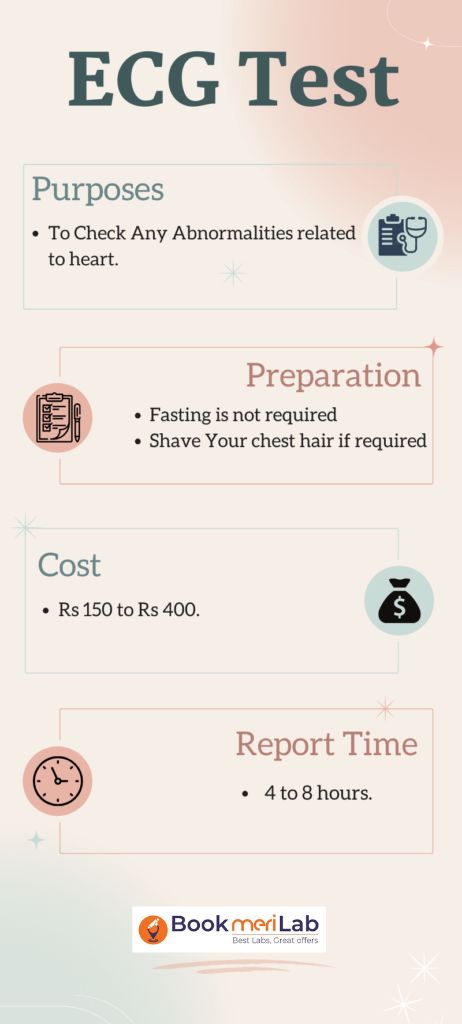
Check the rhythm and electrical activity of the heart
Preparation
No special preparation is required.
Fasting
No fasting is required.
Reporting time
4 to 8 hours.
Cost
Rs 150 to Rs 400.
Table displaying the test details in brief.
ECG Test Price
ECG Test price depends on the diagnostic centre, city and quality of the ECG Scan machine and reputation of the diagnostic centre. However, mostly it ranges from Rs 150 to Rs 400.
The table below lists the prices at some of the popular diagnostic centers in India.
Diagnostic Centre
Indicative price
Dr Lal pathlabs
Not available
Apollo Diagnostics
Not available
City X-ray
Rs 225
Vijaya Diagnostics
Rs 300
NM Medical
Rs 300
Mahajan imaging
Rs 450
Aarthi Scans
Rs 225
Krsnaa Diagnostics
Rs 350
Diagnostic centre wise price list.
Prices tend to vary from one city to another. Usually, metro cities have higher prices, whereas tier 2 or tier 3 cities have lower prices. Table below provides the city-wise price range. You can click on the city name to get the list of ultrasound centres with their prices and discount for ECG tests.
There are different types of ECG tests. Depending on your problem, your doctor may recommend any given ECG.
Resting ECG: The test is done while you lie down. The resting ECG is a simple, painless and quick test. It can diagnose Ischemia and myocardial infarction.
Stress or exercise ECG: This test is carried out on a treadmill. This gives an idea of the functionality of heart under the stressful conditions.
Ambulatory ECG: It is a portable machine attached to your waist. It detects the heart functioning under normal conditions.
Purposes of the ECG:
What does ECG detect?
There are the following purposes of the ECG. Let you have a glance at them:
Routine test: The EKG can also be used as a routine test in certain age groups. It monitors heart health after heart surgery. It is also used as a follow-up test after a patient encounters a heart attack.
Determining the pacemaker’s function: The pacemaker is a device inserted in the chest if you are a heart patient or have a compromised heart function.
To monitor your heart health if you are under medication: It helps to monitor the status of your heart if you are taking some medication that alters heart function.
When to go for ECG?
There are the following conditions under which you must go for ECG:
Abnormally increased heartbeat: Sinus Node is an inbuilt and natural pacemaker. It initiates the heartbeat. Sinus Tachycardia and Atrial flutter are the disorders that contribute to the increased heartbeat.
Irregular heartbeat: It is also known as PSVT, and it occurs due to a short circuit rhythm development in the heart’s upper chamber. The rapid heartbeat starts irregularly and stops abruptly.
Imbalanced Calcium levels: Hypokalemia is the deficiency of Calcium ions in the heart muscles. While Hyperkalemia is the excess amount of Calcium in the heart muscles. Both conditions cause irregularity in the heartbeat.
Blood Clot in the Heart: Coronary Embolism is the condition in which a blood clot jams the artery of a heart.
Heart disorders since birth
Heart attack: It stands for Myocardial infarction ECG. It helps diagnose heart conditions during a heart attack.
ECG Test Preparation
The ECG test requires no special preparation.
Fasting is also not required.
The patient should tell the physician about the medicines he or she is taking.
ECG Test Procedure
The stepwise procedure of the ECG test.
You have to remove your upper clothing. Shave your chest hair, if required.
There are small ECG electrodes attached to the arms, legs, and chest. All these sensors are connected to the machine. Technician would place a total number of 12 electrodes. This placement is known as Leads placement.
You need to remain relaxed and still during the procedure. The Lab technician may ask you to hold your breath for a few seconds.
The heart activity is displayed on paper in graphical form.
The entire procedure takes 10 to 15 minutes.
Result interpretation
ECG result is represented in a graphical form. The cardiologist or heart specialist checks the report carefully.
The table below lists the normal values and indications for abnormal values in an ECG test.
Value
Conclusion
60 to 100 beats per minute
Normal
More than 100 beats per minute
Tachycardia
Less than 60 bpm beats per minute
Bradycardia
(Normal ECG Result. source: Researchgate)
Some of the various Abnormal heart problems that ECG can diagnose include:
Bradycardia: This refers to thedecreased heart rate
Tachycardia: This refers to an increase in heart rate.
Ischemia: It denotes cell death due to the insufficient oxygen supply.
Myocardial infarction: It is known as a heart attack. There is a sudden obstruction in the blood supply to the cardiac muscles.
Heart diseasessince birth: like WFW Parkinson’s syndrome involve an error in the electrical conducting system.
Arrhythmias: It is rapid, slow or irregular heartbeats.
Heart damage due to coronary occlusion (blockage in arteries).
Improper or compromised blood supply to the heart.
Abnormal heart position.
Cardiac inflammation in layers of the heart, Endocarditis, Myocarditis, and Pericarditis.
Cardiac arrest during the intensive care monitoring.
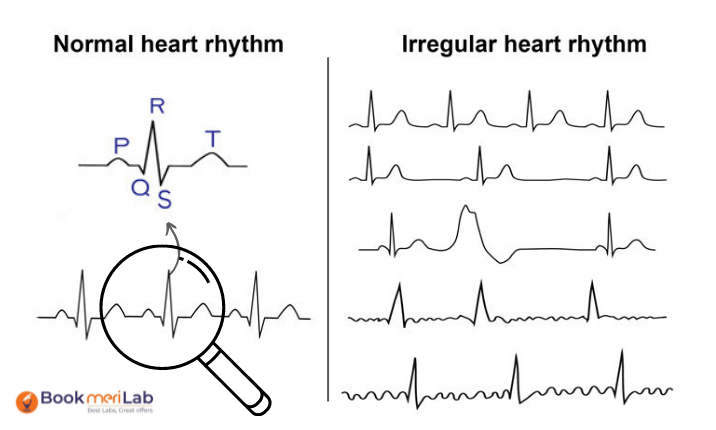
The Normal vs Abnormal result
The graphical representation of the Normal and Abnormal ECG report is given below. However, If your ECG result is abnormal, your doctor will recommend certain other tests or repetition of ECG.
Other Tests linked with the Heart or ECG Test:
The Doctor sometimes provides the following tests to the heart patients to get a clear idea of the progression of the disease.
Physical examination: Listening to heart sounds using a stethoscope.
Magnetic resonance imaging (MRI) or computerised tomography (CT) scans the heart.
Cardiac Catheterisation: It is the insertion of a catheter through the blood vessels of the groin or wrist into the heart.
Echo Test: It is also known as electrocardiography, and it involves the use of ultrasound waves.
Stress Echo Test: This test measures the stress that a heart patient can bear. The Dobutamine stress test is a variation of this test in which a substance is given to a patient that faces some difficulty in running while testing.
Treadmill test (TMT Test): It is performed for the diagnosis of an abnormal heart rhythm of the heart patient.
Holter Test: In the Holter test, the patient wears a chest bearable digital device for recording the heartbeat however it does not give a satisfactory result.
There is a cause and consequence relationship between both.
Cardiac arrest indicates the moment when the heart stops beating.
Heart attack is the most common cause of Cardiac arrest.
In a heart attack, there is damage to the heart muscle due to insufficient oxygen supply.
Frequently asked questions
What if ECG is normal? Is my heart ok?
A typical ECG result does not always mean that you do have not any heart issues. The doctor sometimes prescribes regular follow up tests.
How can I make the ECG interpretation?
The ECG interpretation is a slightly technical task. You should consult your doctor or expert about this.
How to read ECG?
The peaks and crest in the graph are analysed as per the standard results.
What is ECG lead placement?
ECG lead placement is placing the ECG electrodes on your chest and in the space between ribs.
What is the right bundle branch block?
The right bundle branch block is an obstacle in your right bundle branch, and it disturbs its synchronisation with the left bundle branch, creating an error in the heartbeat.
What is left axis deviation (LAD)?
It is a condition representing the error in the electrical axis of ventricular contraction of the heart.
Is ECG at home available?
Yes, the ECG at home is available.
How is privacy maintained in ECG tests for women?
The female expert performs the ECG test for women.
Dr Bhumika Rana is a Bachelor of Ayurvedic Medicine & Surgery (B.A.M.S.). Earlier She was an Operation Specialist at AIIMS Delhi & a Medical officer with the National health mission.