
The Widal test is a blood test that helps doctors diagnose typhoid and paratyphoid fever. These are infections caused by the bacteria Salmonella. Contaminated food and water typically spread these infections. The test determines the number of antibodies the body makes to fight illness. If a person has a higher level of antibodies, it is more likely that they have been infected with the bacteria.
Doctors can use the Widal test to confirm the diagnosis of typhoid or paratyphoid fever and choose the most appropriate course of treatment. Although medical professionals do not consider the Widal test a reliable diagnostic tool for typhoid fever, it can still serve as a helpful tool when used alongside other clinical observations and laboratory tests. The price range of this test is on average between Rs 90 to Rs 300.
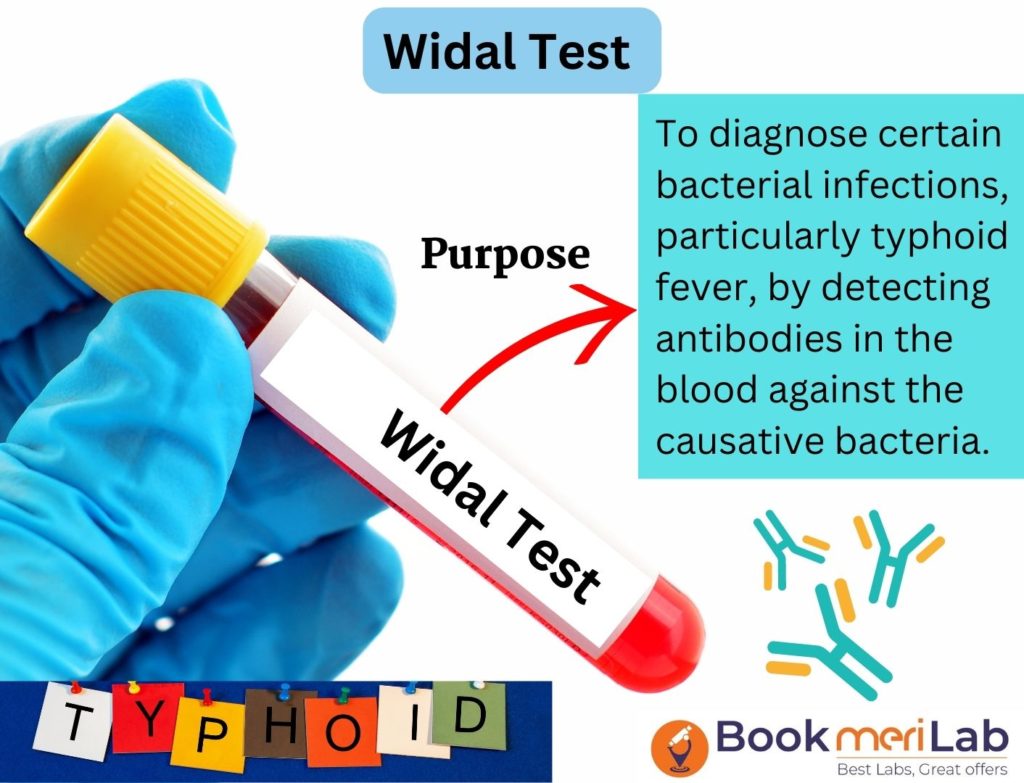

| Also Known As | Typhoid agglutination test, Typhoid fever test, Serum agglutination test, Widal reaction, Widal agglutination test, or Widal serology. |
| Purpose | To diagnose certain bacterial infections, particularly typhoid fever, by detecting antibodies in the blood against the causative bacteria. |
| Preparation | No special preparations are required. |
| Fasting | No |
| Reporting Time | 8 – 24 hours |
| Cost | Rs 90 to Rs 300 |
The Widal test price usually ranges from Rs 90 to Rs 300. The actual price depends on the diagnostic center and the city. Bookmerilab partners with more than 200 diagnostic centers across India. We provide a 10-50% discount on medical diagnostic tests.
The table below lists the prices at some of the popular diagnostic centers.
| Name of Lab | Test Price |
|---|---|
| Redcliffe Labs | Rs 182 |
| City X-Ray | Rs 210 |
| Bharat X-Ray | Rs 162.5 |
| Janta X-Ray Clinic | Rs 168 |
| Prognosis Laboratories | Rs 150 |
| Dr Lal path labs | Rs 300 |
| Aarthi Scans | Rs 90 – Rs 180 |
The Widal test cost depends upon the one recommended by your healthcare professional. The cost varies depending on the lab and the city.
| City | Test Price |
|---|---|
| Widal Test Price in Delhi | Rs 97.5 to Rs 400 |
| Widal Test Price in Mumbai | Rs 180 to Rs 300 |
| Widal Test Price in Bangalore | Rs 180 to Rs 182 |
| Widal Test Price in Hyderabad | Rs 90 to Rs 349 |
| Widal Test Price in Gurgaon | Rs 163 to Rs 400 |
| Widal Test Price in Chennai | Rs 180 to Rs 260 |
| Widal Test Price in Kolkata | Rs 90 to Rs 182 |
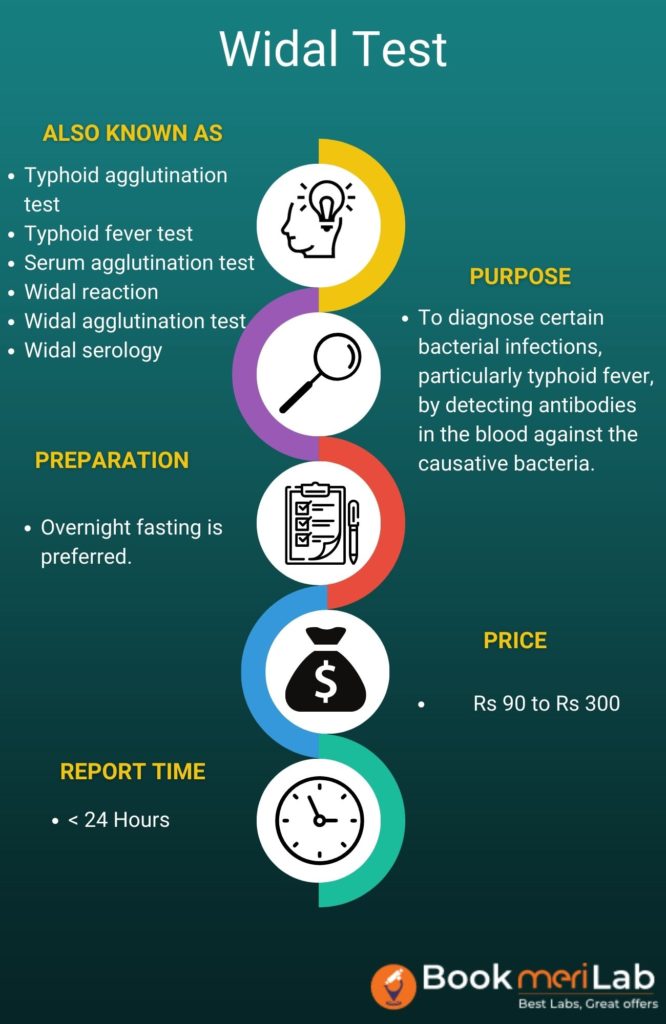
This test does not require any preparation or fasting beforehand. The patient should let the doctor know about any medications they are taking because some drugs may affect the outcome of the test.
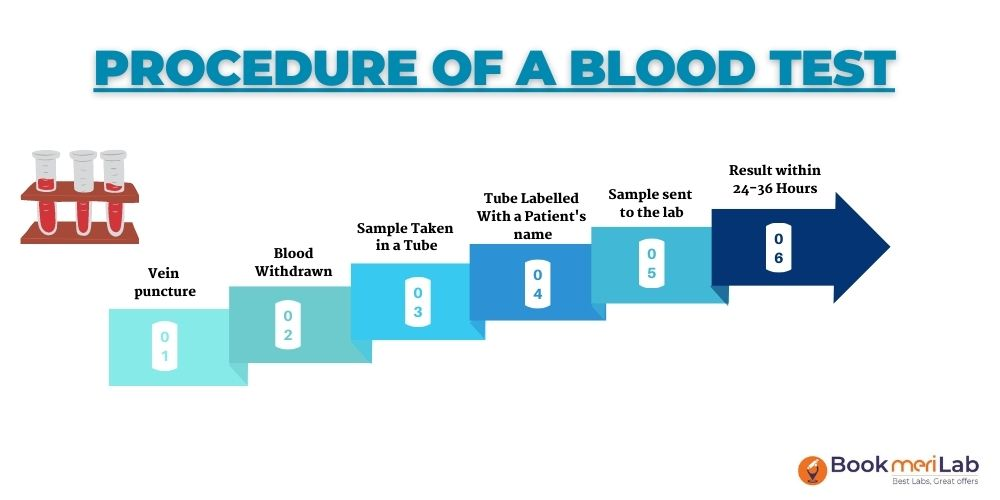
It is a fairly simple diagnostic blood test. Below are the steps to draw a blood sample from the vein in your arm or hand-
The entire procedure takes only a few minutes.
It is a very simple and safe test. The risks involved are the same as that of any other blood test. These include-
Minor pain and bruising that might occur will resolve on their own in a very short time.
The principle of the Widal test is based on the fact that during a typhoid fever infection, the body produces antibodies against the bacteria Salmonella typhi, which causes the disease. The Widal test measures the presence and level of antibodies H and O in a patient’s blood sample for Salmonella typhi bacteria and the ‘H’ antigen of the paratyphi bacteria. O antibody develops initially in acute infection, gradually growing, then declining and generally vanishing within a few months. The H antibody arises later but remains for a longer period of time.
| Antibody | Characteristics | Interpretation |
|---|---|---|
| O (Somatic) | appears early, disappears early | Indicates recent infection |
| H (Flagellar) | appears late, disappears late | lndicates convalescent stage |
1. A negative test result proves that the patient was not exposed to the bacteria that causes typhoid fever because there were no agglutinins detected in their blood.
2. The presence of agglutinins (A substance that makes particles (such as bacteria or cells) stick together to form a clump or a mass) in the patient’s blood confirms exposure to the bacteria that causes typhoid fever, resulting in a positive test result.
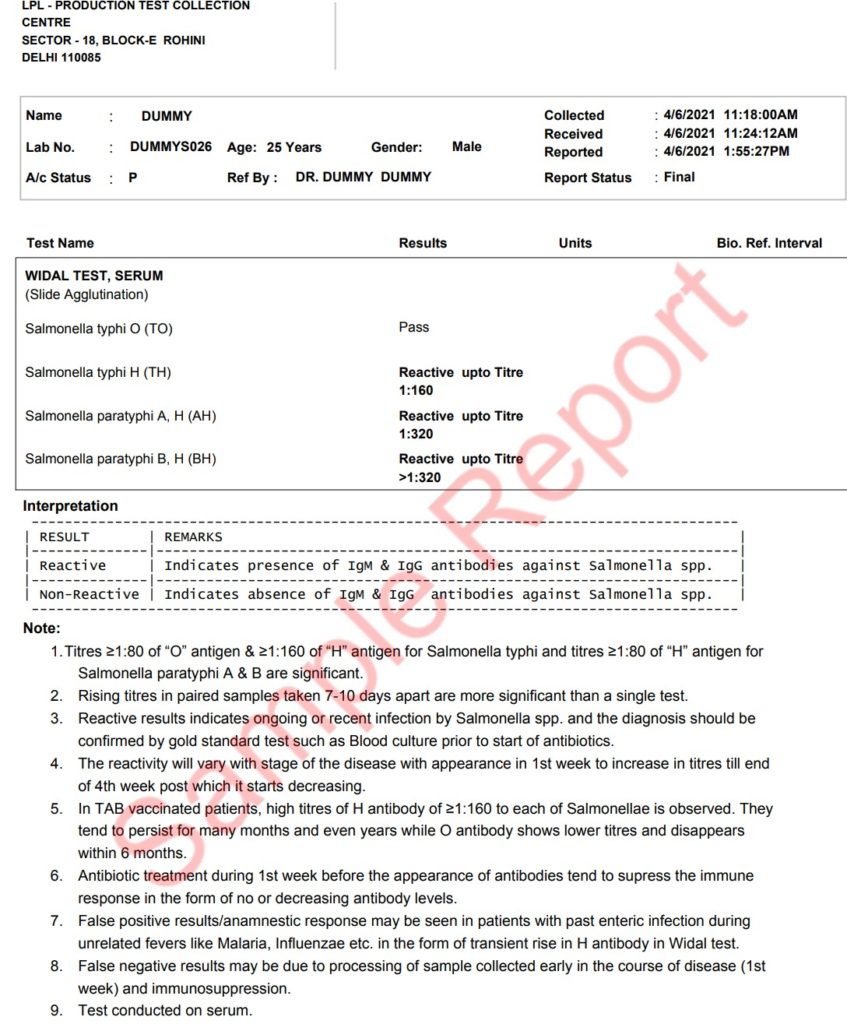
3. Titers: The test result reports the agglutinin titers detected in the patient’s blood. The titer refers to the maximum dilution of the patient’s blood that still shows agglutination. Higher titers indicate a stronger immune response.
| Results | Interpretation |
|---|---|
| Positive | Indicates the presence of IgM & IgG antibodies against Salmonella spp. |
| Negative | Indicates the absence of IgM & IgG antibodies against Salmonella spp. |
Other typhoid agglutination tests like Typhidot Test may also be used by doctors to assist in the diagnosis of typhoid fever.
In conclusion, medical professionals use this test as an antibody test to detect the presence of typhoid fever and to monitor the effectiveness of treatment. It measures the body’s production of antibodies against Salmonella typhi, the bacterium that causes typhoid fever. The healthcare professional interprets the test results by analyzing the presence or absence of agglutinins and the titers of these antibodies in the patient’s blood. Since the Widal test has limitations, healthcare professionals combine it with other diagnostic procedures and clinical data to arrive at a precise diagnosis.
It is used to diagnose typhoid fever, monitor the response to treatment, assess immunity, and detect outbreaks of typhoid fever in populations.
The Widal test involves collecting a blood sample from the patient and measuring the levels of antibodies produced in response to Salmonella typhi, the bacteria that causes typhoid fever.
No fasting is required.
The results usually take a few hours to a few days, depending on the laboratory and the specific test used.
Yes, it can give false positive or false negative results, particularly in acute cases of typhoid fever or in individuals who have received the typhoid fever vaccine. The test should be interpreted in conjunction with other diagnostic tests and clinical findings to make an accurate diagnosis.
A positive test result indicates that the patient has been exposed to Salmonella typhi or Salmonella paratyphi and has developed antibodies against them, suggesting a current or past infection with typhoid fever or paratyphoid fever.
No, this test is not 100% accurate and can produce false-positive or false-negative results.
This test is a relatively safe diagnostic test with minimal risks. However, there is a small risk of infection, bleeding, or bruising at the site of the blood draw.

A Discount Providing Platform on all Diagnostic Services at your nearest Labs. 100's of Certified Labs, Assured Quality & Great Discounts.
