
A D-dimer test identifies blood clotting disorder. D-dimer is a protein fragment (small piece) that appears in the body as a by-product of blood clot dissolution. D-Dimer Test price ranges from Rs 900 to Rs 1800 in India.
Blood clotting is a necessary process that prevents blood loss during an injury. Usually, the body dissolves the clot after completely healing a wound. However, in a blood clotting disorder, clots form even without apparent injury, and these clots don’t dissolve when they should. These conditions can cause serious and life-threatening issues. The high plasma D-dimer concentration signifies intravascular(in blood circulation) fibrin formation. D-Dimer test determines the Fibrin degradation assessment.
| Also known as | fragment D-dimer, fibrin degradation fragment |
| Purpose | Blood clotting abnormalities |
| Preparation | No special preparation is required |
| Fasting | No fasting is required |
| Reporting time | 24 hours |
The test price depends on the diagnostic centre, city and home collection. However, generally, it would range from Rs.
| Popular Lab | Price |
|---|---|
| Dr lalpathlab | Rs |
| City X-ray | Rs 900 |
| Janta X-ray | Rs 1620 |
| Ganesh diagnostics | Rs 1200 |
| Mahajan Imaging | Rs 960 |
| National Imaging | Rs 1620 |
| Prognosis laboratories | Rs 660 |
The table below lists the prices for popular diagnostic centres.
| City | Price |
|---|---|
| D-dimer test cost in Delhi | Rs 660 to 1620 |
| D-dimer test cost in Gurgaon | Rs 767 to 1018 |
| D-dimer test cost in Chandigarh | Rs 924 to 1080 |
| D-dimer test cost in Chennai | Rs 810 to 1080 |
| D-dimer test cost in Kolkata | Rs 810 to 1080 |
| D-dimer test cost in Pune | Rs 924 to 1080 |
| D-dimer test cost in Hyderabad | Rs 1080 to 1323 |
| D-dimer test cost in Mumbai | Rs 810 to 1080 |
The D-dimer test is useful in the diagnosis and monitoring of the following disorders, including
The quantitative D-dimer normal range is given below:
| value | Remarks |
|---|---|
| less than 0.50 ng/ml | Normal and no serious blood clot. |
| More than 0.50 ng/ml | An active blood clot. |
Negative Report: This indicates that the person is. Normal and the D-dimer range is within normal ranges. This means that you probably do not have problems with blood clotting.
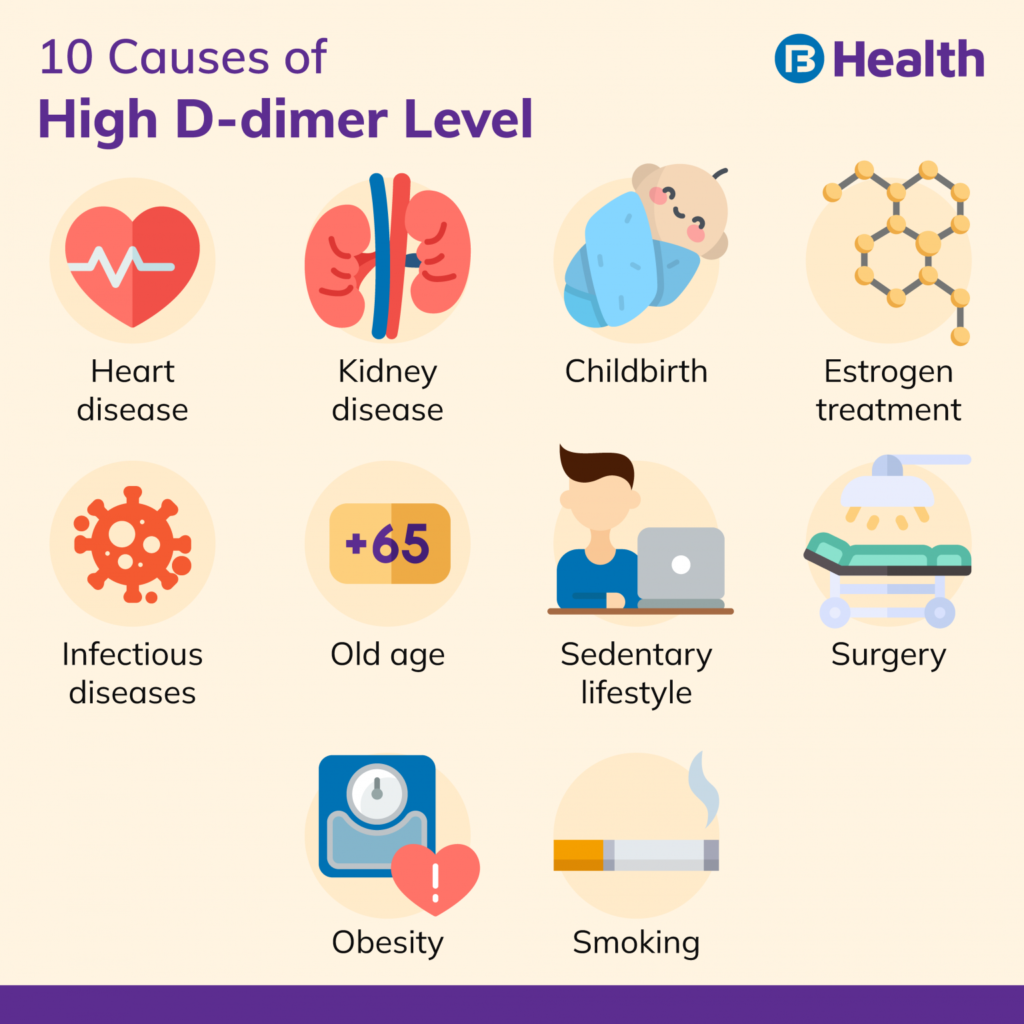
D-Dimer levels are increased in DIC / Intravascular coagulation, recent bleeding, hematoma, trauma, surgical operation and thromboembolism. High levels may also be seen in pregnancy, liver disease, malignancy, inflammation & chronic hypercoagulable state.
Higher than normal D-dimer levels: The clotting problems do not always cause high D-dimer levels. However, there may also be different reasons other than clotting issues behind the increased D-dimer levels in some cases.
There are the following methods of improving the unbalanced blood clotting in patients.
Vitamins and food that increase blood clotting (Coagulation)
Vitamins and food that decrease blood clotting (Coagulation)
A false positive may be detected besides the above reasons for a high d-dimer lever. There are following other factors that may cause a false positive test.
There are the following risk factors behind blood clot formation in humans.
Though the D-dimer test can indicate a blood clotting disorder, it can not locate the location and reason for clotting. Sometimes, a person with a normal d-dimer report can show persistent symptoms. Thus further diagnosis and investigation are necessary. Some important tests are
No special preparation is required.
The D-dimer is a simple blood test. The procedure steps are as follows:
D Dimer Test
A D-Dimer report lists the D-Dimer level along with the reference range used by the lab, so you can see at a glance whether your result falls inside or outside the normal range.
| Parameter | Result | Unit | Reference Range |
|---|---|---|---|
| D-Dimer | Patient value | ng/mL FEU (or µg/mL FEU, depending on the lab's method) | Typically < 0.50 µg/mL FEU (labs vary — always check the range printed on your own report) |
A result above the lab's reference range flags increased clot formation or breakdown and needs correlation with your symptoms and other tests (it does not, by itself, diagnose a specific condition); a result within range makes an acute clotting disorder such as DVT or pulmonary embolism unlikely.
D-dimer is a small piece of protein, and it appears in the blood after the blood clot dissolution.
The D-dimer test levels also indicate the presence of different types of cancer, cardiovascular diseases(heart diseases), and pulmonary embolism(blood clots in the lungs’ blood vessels).
References:
A Discount Providing Platform on all Diagnostic Services at your nearest Labs. 100's of Certified Labs, Assured Quality & Great Discounts.
