
Dengue NS1 antigen rapid test can detect Dengue on the first day of the fever. This disease is a viral infection carried by mosquitoes. Its symptoms appear in 3-14 days after the infected mosquito bites a person. The method of testing is known as the ELISA (enzyme-linked immunoassay). Therefore, this test is also known as Dengue NS1 antigen ELISA.
The infected person has a fever, headache, pain in joints and muscles, etc. In severe cases, Dengue can be fatal. The proteins produced by the virus cause an immune response by producing antibodies to fight against the dengue infection. The price range of Dengue NS1 Antigen test is usually between Rs 270 to Rs 1500.
Antigens are the protein structure in the Dengue-causing microorganism. These antigens stimulate the immune system to produce antibodies in the blood. Dengue infection occurs due to the secretion of non-structural NS1 protein into the blood. Non-structure means the non-uniform and not well-organized structure of the protein. The test detects dengue NS1 protein and toxins produced by the dengue virus.
Physical touch: Dengue cannot spread by contact with an infected person.
Eating together: Dengue does not spread if two or more persons eat together or share food.
| Also Known As | Dengue Rapid Test, Dengue NS1 Ag Test, NS1 Antigen Rapid Test, Dengue Fever NS1 Ag Test, Dengue Ag NS1 Test, Dengue Early Detection Test |
| Purpose | To detect the presence of dengue virus in the early stages of infection. |
| Preparation | No special preparation required. |
| Fasting | No |
| Reporting Time | 8 to 24 Hrs. |
| Cost | Rs 270 to Rs 1500 |
Test Price usually ranges from Rs 270 to Rs 1500. The actual price depends on the diagnostic center and the city. Bookmerilab partners with more than 200 diagnostic centers across India. We provide a 10-50% discount on medical diagnostic tests.
The table below lists the prices at some of the popular diagnostic centres.
| Name of Lab | Test Price |
|---|---|
| Redcliffe Labs | Rs 570 |
| Janta X Ray Clinic | Rs 1020 |
| City X-Ray | Rs 960 |
| Prognosis Laboratories | Rs 600 |
| National Imaging | Rs 980 |
| Bharat X Ray Clinic | Rs 1040 |
| Dr Lal path labs | Rs 600 |
| Aarthi Scans | Rs 540 |
The test cost depends upon the one recommended by your healthcare professional. The cost varies depending on the lab and the city.
| City | Test Price |
|---|---|
| Dengue Test Price in Delhi | Rs 500 to Rs 1280 |
| Dengue Test Price in Mumbai | Rs 570 to Rs 1280 |
| Dengue Test Price in Bangalore | Rs 360 to Rs 540 |
| Dengue Test Price in Hyderabad | Rs 270 to Rs 987 |
| Dengue Test Price in Gurgaon | Rs 270 to Rs 1280 |
| Dengue Test Price in Chennai | Rs 540 to Rs 600 |
| Dengue Test Price in Kolkata | Rs 450 to Rs 1500 |
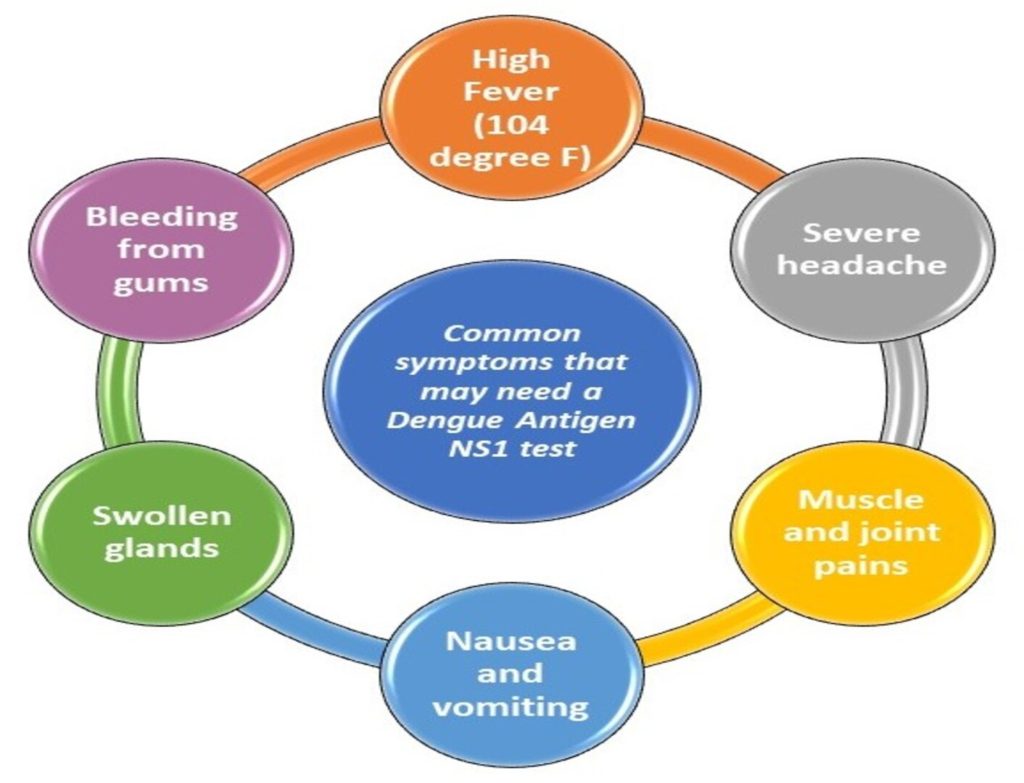
If you notice some of the following symptoms, then you may go for the test.
No preparation is required for the dengue NS1 antigen test. The technician will withdraw a sample of blood through a vein puncture. The NS1 can be detected during the acute phase of infection. Dengue NS1 antigen sensitivity can be sensitive as a molecular test in the first seven days of symptoms. The dengue NS1 antigen test is not recommended after a week.
The Dengue NS1 antigen reactive means your body has developed Dengue. The dengue ns1 antigen test positive result indicates your body has the active form of infection with the dengue virus. The NS1 antigen is usually identified within 1-2 days after the person is infected, and the result is positive up to 9 days after the symptoms appear.
The Dengue NS1 antigen is non-reactive means your body has not developed Dengue. The result is interpreted negatively when the dengue NS1 antigen is constant in the absence of the phase of infection. The result may be negative if the sample is collected too soon (less than 24-48 hours).
The chart below can help you understand the result and its meaning. The positive denotes an abnormal value i.e. presence of the dengue virus. Dengue NS1 antigen normal value indicates a negative result.
| RESULT | REMARKS |
| -ve (less than 0.9) | Dengue NS1 antigen is not detectable. You may be advised to go for additional tests to check the presence of dengue IgM antibodies. |
| +ve (more than 0.9-1.1) | Dengue NS1 antigen is present. |
| (0.9-1.1) | Patient is required to repeat the test after 7 days. |
When interpreting the results, the Dengue antigen NS1 test has various restrictions and dangers that should be taken into account. The test only works in the first stages of infection, usually within the first week of symptoms, which is one of its limitations. It’s possible that the test won’t find the virus if it’s run later on in the infection. False negative results could also come from some people not producing enough of the antigen to be detected.
The test does not carry any significant risks, however a few individuals may feel some minor pain or discomfort where the blood was drawn.
In order to confirm a dengue diagnosis, the test should be used in conjunction with clinical symptoms and other diagnostic techniques. It’s vital to remember that a negative result does not rule out dengue infection.
A diagnostic method for finding dengue virus in a person’s blood is the Dengue Antigen NS1 test. The test is often administered within a week after the onset of symptoms in the early stages of dengue infection. An excellent sign of dengue infection is the presence of the NS1 antigen, a protein generated by the virus.
The test can identify very low quantities of the virus in the blood and is highly sensitive and specific, thus it is unlikely to give false positive findings. To confirm a dengue diagnosis, however, the test should be used in conjunction with other diagnostic techniques, such as RT-PCR.
Results read after 20 minutes would be considered invalid.
The female mosquitoes, mainly Aedes aegypti, spread the Dengue virus.
No. Dengue does not spread from breathing.
Prevent stagnation of water around your residence. Use mosquito repellant spray or body lotion.
Dengue haemorrhagic fever causes break-bone fever. It causes pain in eye sockets, bone joints, and the skull.
Yes Dengue can cause the pleural effusion. This symptom involves the accumulation of water in the pleural membranes. Dengue also causes acute respiratory distress syndrome (ARDS), involving the accumulation of fluid inside the lungs.
A Discount Providing Platform on all Diagnostic Services at your nearest Labs. 100's of Certified Labs, Assured Quality & Great Discounts.
